Christo and Jeanne-Claude transformed public spaces into extraordinary works of art, captivating audiences worldwide.
Their innovative projects, often involving the wrapping and draping of iconic structures, challenged conventional perceptions of art and its relationship with the environment.
From the Wrapped Reichstag in Berlin to The Gates in Central Park, their creations invited viewers to experience familiar landmarks in an entirely new light.
Born on the same day in 1935, this dynamic duo forged a partnership that blended romance and creativity for over five decades.
Their collaborative efforts not only reshaped landscapes but also sparked conversations about the nature of public art and its role in society.
By embracing a quasi-legal approach to their work, they pushed boundaries, encouraging audiences to engage with art beyond traditional gallery settings.
As we explore their most significant contributions, it becomes clear that Christo and Jeanne-Claude’s legacy continues to inspire and challenge the art world today.
1. Wall of Oil Barrels – Rideau de Fer (The Iron Curtain) (1961-62)
Source: crash.fr
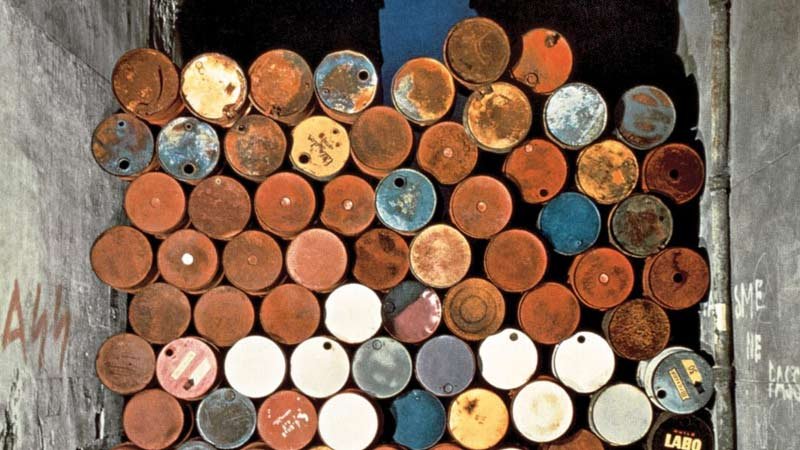
Christo and Jeanne-Claude created “Wall of Oil Barrels” as a powerful reaction to the construction of the Berlin Wall.
This installation featured a barricade made of oil barrels, standing four meters high and blocking Rue Visconti for eight hours.
The barrels retained their original industrial appearance, with visible colors, brand names, and rust. This transformation turned the street into a dead end, making a bold statement about division and isolation.
Through this art piece, they provoked meaningful discussions on the implications of borders in society.
2. Wrapped Coast (1968-69)
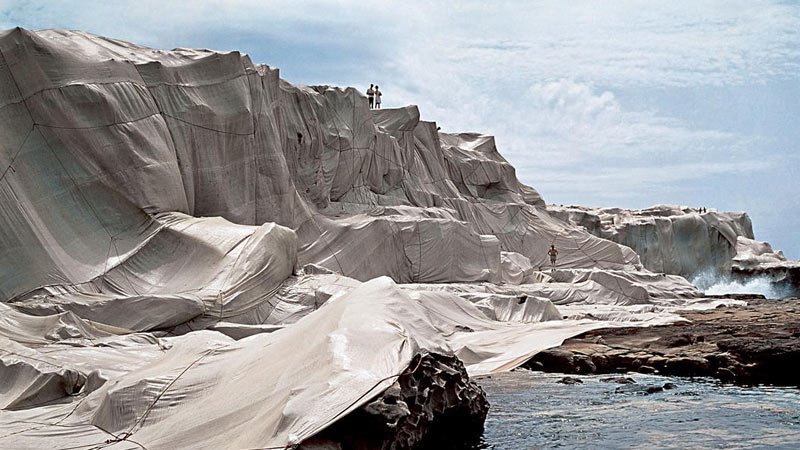
Wrapped Coast represents a groundbreaking installation by Christo and Jeanne-Claude. Stretching over two kilometers along the coast of Little Bay in Sydney, Australia, this project involved covering 2.4 million square feet of land with fluctuating shades of fabric.
Delivered in the late 1960s, it transformed the natural landscape into a vibrant canvas, altering the perception of the coastline.
Capturing the attention of local communities, Wrapped Coast encouraged visitors to explore the area in new ways. People walked around and beneath the fabric, experiencing a blend of art and nature.
This installation sparked conversations about the relationship between human intervention and the environment while highlighting the ephemeral nature of art.
3. Valley Curtain (1975)
Source: artnews.com
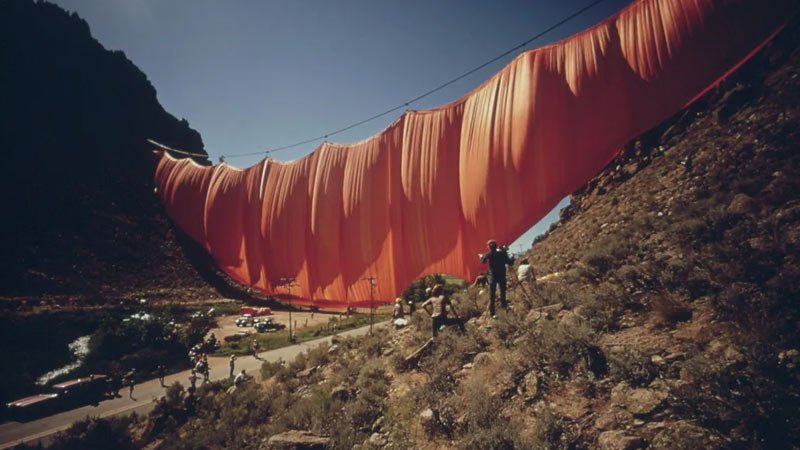
Valley Curtain was a monumental installation created by Christo and Jeanne-Claude in Colorado. Stretching 200,209 square feet, it featured a bright orange woven nylon fabric that bisected a valley.
The curtain was anchored between two mountain tops and could be seen from miles away, offering a striking contrast against the natural landscape.
Creation began in 1970, and the team faced numerous challenges. On October 9, 1971, high winds disrupted their first attempt, causing the fabric to tear.
Finally, on August 19, 1972, the artwork was successfully erected but lasted only 28 hours before a 60-mile-per-hour wind forced its dismantling.
Even in this brief period, it allowed cars to pass underneath, capturing the imagination of many visitors.
4. The Umbrellas (1984-91)
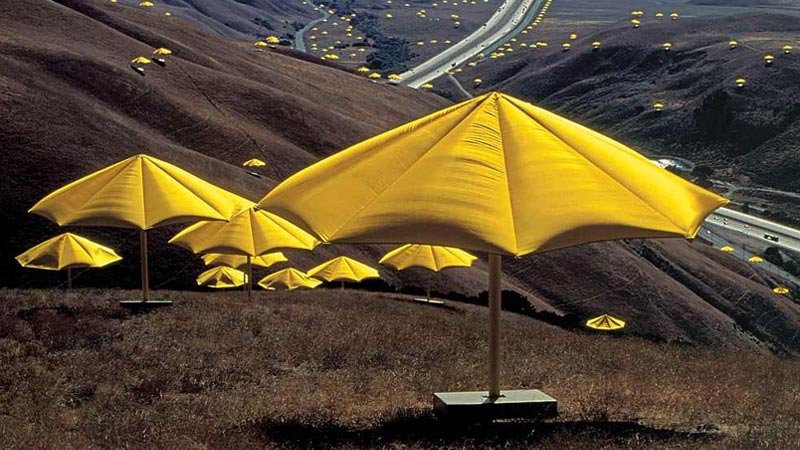
The Umbrellas installation occupied two contrasting locations: Japan and California. In Japan, 1,340 blue umbrellas, chosen for their connection to the area’s lush vegetation and water, formed a dense display.
Umbrellas arranged in close proximity mirrored the geometry of the surrounding rice fields, deepening the overall aesthetic experience.
Meanwhile, California featured 1,760 yellow umbrellas, reflecting the golden hues of local grazing hills. These umbrellas spread out across the vast agricultural landscape, emphasizing the expansive nature of the Central Valley.
Notably, the umbrellas stood 19 feet high and spanned 28 feet wide, crafted from fabric, aluminum, and steel, supported by wooden structures.
The unified use of color and scale in both locations showcased similarities and differences in land usage and cultural identity.
This installation highlighted how art can interact with and transform the environment, prompting discussions about community and landscape involvement.
5. Wrapped Reichstag (1971-95)
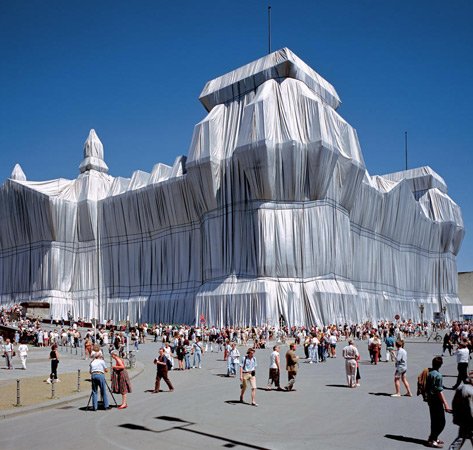
Wrapped Reichstag captured the imagination of millions, with the installation attracting a vast number of visitors during its brief two-week existence.
Artists Christo and Jeanne-Claude draped 1,076,390 square feet of shiny aluminum-based polypropylene fabric over the famous Berlin building.
Unique blue polypropylene ropes outlined the façade, highlighting its architectural features and emphasizing the shift in German identity post-reunification.
In 1995, the project symbolized a renewed relationship between East and West Germany, reflecting the country’s transformation.
Although the project was proposed in 1971, it took nearly 25 years for approval to be granted. Wrapped Reichstag stands as a powerful testament to the artists’ vision, combining a modern aesthetic with a deep political statement.
6. The Gates (1979-2005)
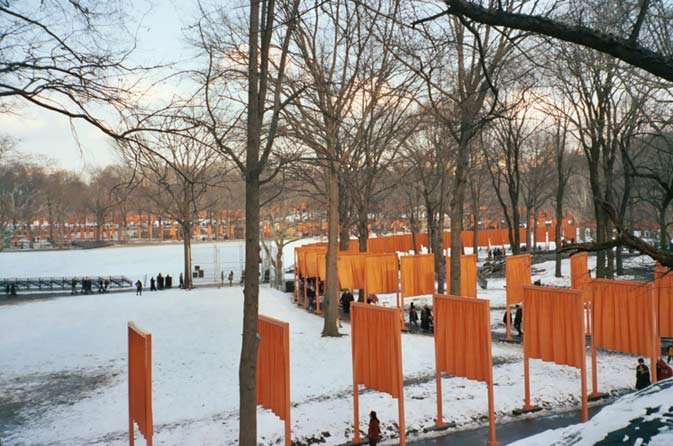
Christo and Jeanne-Claude unveiled The Gates in Central Park in 2005. Stretching across 23 miles of walkway, this installation featured 7,503 steel gates, each standing 16 feet tall. The vibrant saffron-colored cloth panels draped elegantly, creating a stunning visual effect.
Visitors flocked to the park, with over four million people experiencing this transformation in just 16 days. The installation encouraged people to engage with Central Park in a fresh way, altering perceptions of the space.
Its temporary nature emphasized the ephemeral quality of art, inviting dialogue about public art’s role.
The Gates remains a significant milestone in their collaborative work, showcasing their ability to merge creativity with public spaces beautifully.