Ithell Colquhoun, a pioneering figure in the realm of surrealism, is increasingly recognized for her unique contributions to the art world.
Born in 1906, she skillfully blended the mystical with the tangible, creating works that resonate with both emotion and intellect.
Her art, often inspired by spiritualism and automatic drawing, invites viewers into a realm where the subconscious takes center stage.
Colquhoun’s paintings, such as “Oil on a Wet Road” and “Nativity,” showcase her mastery of color and form, while her exploration of themes like identity and the metaphysical challenges traditional artistic boundaries.
As exhibitions continue to highlight her legacy, it’s clear that Colquhoun’s work not only reflects her time but also offers a timeless commentary on the human experience.
Delving into her art reveals a world rich with symbolism and depth, making her an essential figure in understanding the evolution of modern art.
1. Song of Songs (1933)
This painting marks a pivotal moment in Ithell Colquhoun’s artistic journey. By 1936, she left any obvious human figures behind and delved into nature’s macrocosm, focusing on flowers and plants.
2. Pitcher-plant (1936)
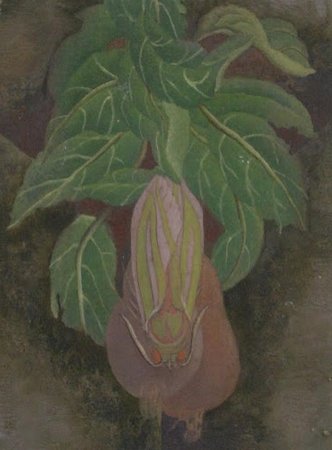
“Pitcher-plant” showcases a union of male and female genitalia through the dissection of a Pitcher plant. This piece embodies the ideal of the hermaphrodite, where opposites blend harmoniously rather than exist in conflict.
A delicate flower hangs at the base, resembling testicles in pale pinks and yellows. In doing so, it provides an early glimpse into her exploration of botanical themes, leading her toward Surrealism in the mid-1930s.
The painting invites intriguing comparisons to Georgia O’Keeffe’s works, reflecting shared motifs in nature.
Also, Salvador Dalí’s influence is evident as he introduced phantasmic presences, personifying nature similarly.
Oil on canvas – Collection of The National Trust, United Kingdom
3. Scylla (1938)

Source: tate.org.uk
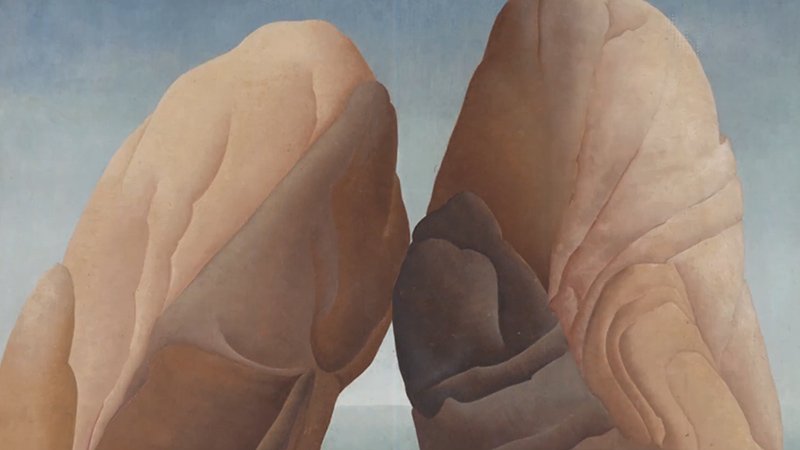
“Scylla” stands out as one of Colquhoun’s most important works. It features two large vertical rocks emerging from clear water, forming a crevice below.
The colossal stones evoke both phallic and feminine imagery, mirroring the introspective figures seen in René Magritte’s art.
A small white boat ventures through the channel, emphasizing her Surrealist connections. Colquhoun’s ability to create a double image is evident here, illustrating the fluid transition where earth meets sea.
Oil on board – Collection of the Tate, United Kingdom
4. The Pine Family (1940)
Source: artnet.com
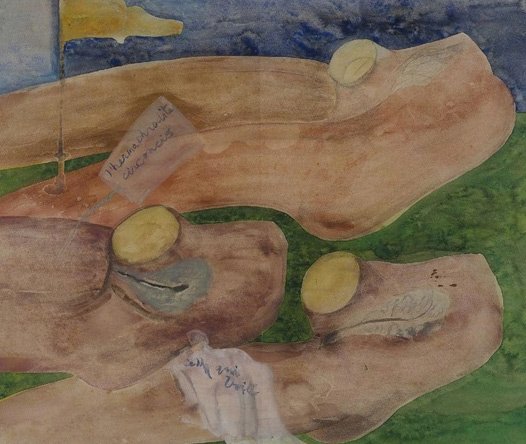
“The Pine Family” reflects somber themes through its depiction of three felled trunks on grass under a blue sky. Each stump bears a chilling white tag, evoking imagery of dismembered bodies.
This resonates with the immense loss during World War II, suggesting echoes of lives reduced to mere objects during the Holocaust.
The painting underscores the proximity of death, reminding viewers of the shared design between humanity and nature.
Oil on canvas – Collection of Israel Museum, Jerusalem, Israel
5. Tree Anatomy (1942)

Source: ithellcolquhoun.co.uk
“Tree Anatomy” replaces the earlier “Pine Family” in a 1942 exhibition. At first glance, the artwork features a cross-section of tree innards, showing a large knot leading to a dark void.
However, it also reveals a secondary image suggesting a vagina, aligning with Colquhoun’s belief in the eternal connection between nature and femininity.
Oil on panel – Private Collection
6. Alcove II (1948)
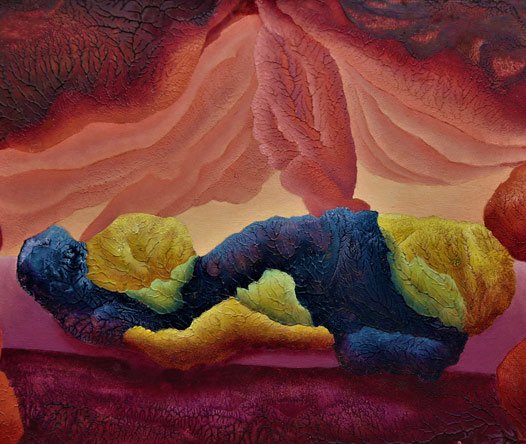
Source: ocula.com
“Alcove II” captivates with an undefined writhing form in shades of blue, green, and yellow, set against a backdrop of reds and pinks.
This piece reflects Colquhoun’s automatic style of decalcomania, where paint interacts with paper to create unexpected imagery. The random blotting adds depth to her exploration of abstraction in nature.