
The Crucifixion of Jesus Christ stands as one of the most profound symbols in Western culture, embodying themes of hope and redemption.
Artists throughout history have captured this powerful moment on canvas, creating masterpieces that resonate deeply within the Christian faith.
From the Middle Ages to the Renaissance, the depiction of Christ on the cross has evolved, reflecting the artistic movements of each era.
With countless interpretations, the Crucifixion has inspired some of the most iconic artworks in history. These paintings not only showcase the technical skill of their creators but also invite viewers to explore the complex emotions surrounding sacrifice and salvation.
In this article, we’ll delve into ten of the most famous Crucifixion paintings, examining how each artist uniquely represents this pivotal event and its enduring significance in art and culture.
1. Christ Crucified – Diego Velázquez

Velázquez completed “Christ Crucified” in 1632, showcasing a stark and serious depiction of Jesus on the cross.
The painting stands out for its nearly lifelike representation, inviting viewers to connect deeply with Christ’s suffering.
While Velázquez created it after his return from Italy, its subdued emotion contrasts with his other works, reflecting a profound exploration of sacrifice.
This masterpiece is currently displayed at the Museo del Prado in Madrid, where it’s admired for its captivating realism and emotional weight.
2. Corpus Hypercubus – Salvador Dalí

Dalí painted “Corpus Hypercubus” in 1954, using oil on canvas to create a surreal reinterpretation of the Crucifixion.
He visually suspends Jesus from a polyhedral net of a tesseract hypercube, merging classical elements with scientific inspiration.
The painting’s Caravaggesque lighting dramatically highlights Christ’s figure, emphasizing both divinity and humanity.
Dalí’s innovative approach illustrates his belief that science and religion can coexist, offering a fresh perspective on the traditional biblical scene.
3. Mond Crucifixion – Raphael

Raphael’s “Mond Crucifixion,” painted between 1502 and 1503, exemplifies early Renaissance artistry. It features an intricately detailed landscape, showcasing his mastery of perspective.
Two angels catch Christ’s blood in chalices, highlighting the sacred moment. The Virgin Mary Magdalene, Saint Jerome, and John the Evangelist flank the scene, enriching its emotional depth.
Inscribed at the foot of the cross is Raphael’s signature, underscoring his artistic identity. This monumental work, also known as the Gavari Altarpiece, reflects Raphael’s early genius and influences from fellow Umbrian artist Perugino.
4. Crucifixion of St. Peter – Caravaggio

Caravaggio’s “Crucifixion of St. Peter,” painted in 1601, portrays the intense moment of Saint Peter’s martyrdom. It features three executioners struggling to raise Peter’s cross.
Peter, depicted in a frail yet muscular state, twists his body in a desperate search for divine comfort. His upside-down position symbolizes his humility and unworthiness compared to Jesus.
This powerful Baroque painting is housed in the Cerasi Chapel of Santa Maria del Popolo in Rome, showcasing Caravaggio’s mastery of chiaroscuro and emotional intensity.
5. The Crucifixion of St. Peter – Michelangelo

Michelangelo’s “The Crucifixion of St. Peter,” created circa 1545-1550, captures a dramatic moment of martyrdom. The fresco depicts Peter being hoisted onto the cross by Roman troops, emphasizing human suffering.
Michelangelo’s intense focus on anatomical detail highlights Peter’s frailty alongside his remarkable strength.
Set in the Cappella Paolina, Vatican City, this piece powerfully conveys the emotional turmoil of sacrifice, making it a significant work in Renaissance art.
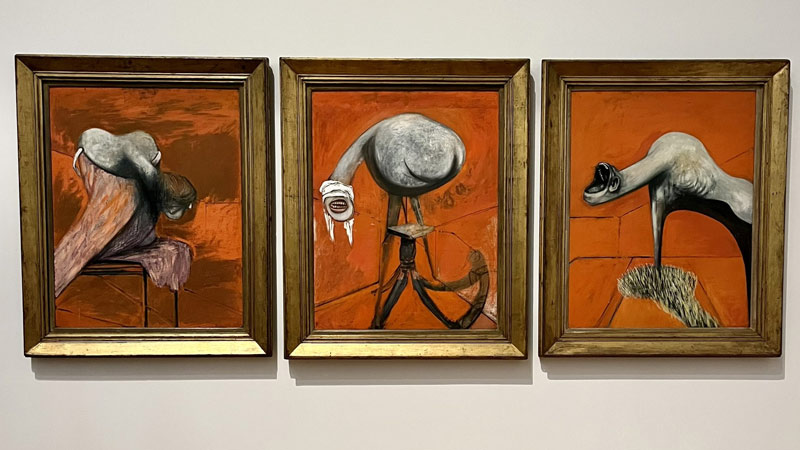
6. Three Studies for Figures at the Base of a Crucifixion – Francis Bacon
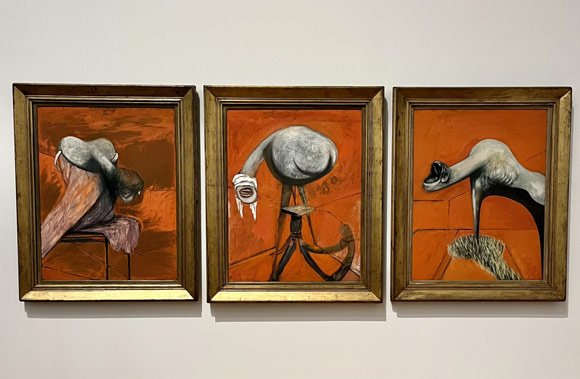
Francis Bacon’s “Three Studies for Figures at the Base of a Crucifixion,” completed in 1944, presents a haunting portrayal of human suffering.
This triptych features three writhing figures, visually resonating with the themes of agony and despair. Set against a flat, burned orange background, the figures evoke deep emotional turmoil.
Bacon’s exploration of the Eumenides from Aeschylus’s “Oresteia” underscores his fascination with myth and suffering, making this work a striking commentary on the human condition.
7. Crucifixion with a Donor – Hieronymus Bosch
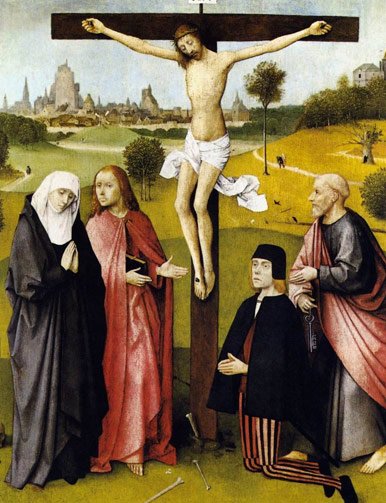
Bacon’s “Crucifixion with a Donor,” painted around 1480-1485, showcases a unique blend of symbolism and narrative.
Bosch depicts Jesus on the cross, surrounded by a detailed landscape and muted tones that enhance the calm aesthetic.
A benefactor appears in the foreground, emphasizing the connection between piety and personal sacrifice.
The serene drapery and subtle gradations of color draw viewers into the profound emotional depth, while Bosch’s distinctive style reflects his exploration of spiritual themes intertwined with human experience.
8. The Crucifixion of Saint Andrew – Caravaggio

Caravaggio’s “The Crucifixion of Saint Andrew,” painted in 1607, captures the intense martyrdom of the apostle. He depicts Saint Andrew tied to an X-shaped cross, showcasing his anguish and determination.
The dramatic chiaroscuro highlights Andrew’s expressions and struggle, immersing viewers in the moment. The Spanish Viceroy of Naples initially took this powerful piece to Spain in 1610.
Now part of the Cleveland Museum of Art, it serves as a poignant exploration of faith and sacrifice in Baroque art.
9. Crocifissione – Masaccio

Masaccio’s “Crocifissione,” created around 1426, is a tempera painting that originally formed part of the Polyptych of Pisa.
This artwork measures 83 by 63 centimeters and captures the poignant moment of Christ’s crucifixion. Three mourners Virgin Mary, St. John, and Mary Magdalene—kneel in the center, expressing profound sorrow.
Masaccio’s vivid use of color and dramatic gestures creates an emotional focal point, particularly highlighted by Mary Magdalene’s iconic red dress, emphasizing her desperation and grief. Currently, it’s displayed at the Naples National Museum of Capodimonte.
10. Christ of Saint John of the Cross – Salvador Dalí

Salvador Dalí painted Christ of Saint John of the Cross in 1951, showcasing a unique vision of the Crucifixion. He positions Christ above a darkened sky, reflected in a serene body of water, highlighting the contrast between suffering and tranquility.
Influenced by John of the Cross’s mysticism, Dalí’s bird’s-eye perspective invites introspection. Housed in the Kelvingrove Art Gallery and Museum, this iconic artwork embodies Dalí’s return to faith, merging traditional religious themes with his surrealist style.


