

Jean-Michel Basquiat’s art transcends time and continues to captivate audiences worldwide. Emerging from the vibrant streets of Brooklyn, his unique style combines elements of graffiti, expressionism, and social commentary, making him a pivotal figure in contemporary art.
Despite his untimely death at just 27, Basquiat’s works have skyrocketed in value, with original pieces fetching over $30 million at auction.
From bold colors to intricate symbolism, these masterpieces reflect a deep critique of societal norms and injustices.
As his legacy endures, experiencing these iconic works offers a glimpse into the mind of one of the 20th century’s most influential artists.
1. Untitled (1982)
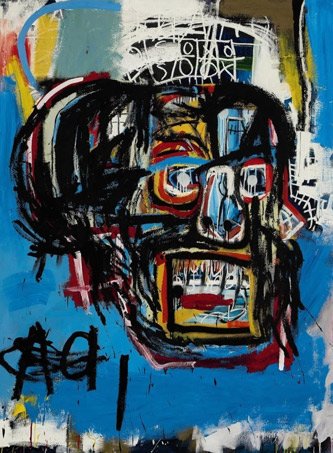
Jean-Michel Basquiat’s “Untitled” from 1982 stands out as one of his most iconic works. The painting features a striking skull rendered in aggressive black strokes, accented by splashes of red, yellow, and white against a vibrant blue background.
Originally, the piece was acquired for just $4,000 by the Annina Nosei Gallery in New York. Following its initial sale, it transitioned through several ownerships before being auctioned at Christie’s in 1984 for $20,900 to collectors Jerry and Emily Spiegel.
This artwork captures not only Basquiat’s distinctive style but also the social and political themes he explored during the early 1980s.
2. In Italian
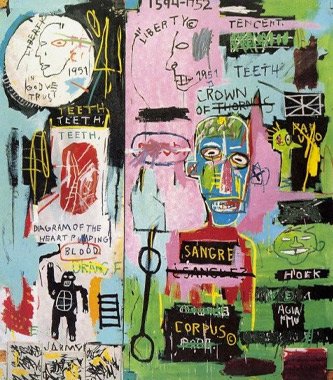
“In Italian” stands out as one of Basquiat’s most captivating and impactful works. This painting showcases a dynamic fusion of text, color, and symbolism that immerses viewers in its rich narrative.
Featuring profoundly expressive brush strokes, it reveals Basquiat’s commentary on culture and identity. The vibrant palette conveys emotion while the juxtaposition of language highlights his fascination with linguistic play.
Resulting in an unforgettable visual experience, “In Italian” exemplifies Basquiat’s ability to transcend traditional boundaries.
Such artistry reflects the vibrant energy of urban life, making it a celebrated piece in his oeuvre. The allure of this artwork continues to resonate, drawing collectors and enthusiasts alike.
3. Warrior
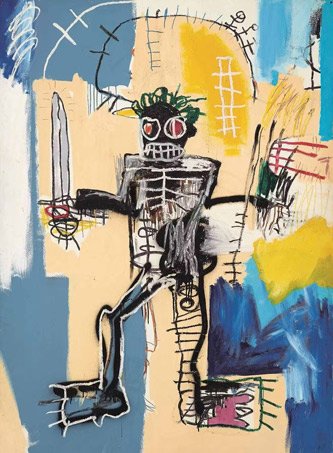
“Warrior” captures Basquiat’s raw emotional energy through a vibrant backdrop of yellow and blue. The striking crowned figure, brandishing a sword, symbolizes invincibility and strength.
Critics often note how this piece embodies Basquiat’s experiences as a black artist during the 1980s, showcasing his unique perspective.
This masterpiece achieved a remarkable auction price of $417 million in 2021, reflecting its significance in the art world.
The fusion of spray paint, oil stick, and acrylic illustrates his frantic creative process, making “Warrior” a pivotal work in his portfolio.
4. Dustheads
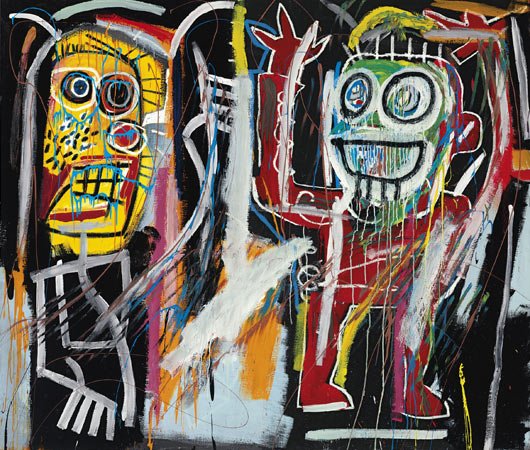
“Dustheads,” created in 1982, showcases two sticklike characters against a dark backdrop. One figure stands out in striking red, its arms flailing while its eyes spin wildly.
The second character, though less animated, shares the same masklike face and spiraling eyes, creating a haunting visual narrative.
This painting delves into the chaotic effects of altered states, possibly influenced by Basquiat’s experiences with drug culture in 1980s New York.
Selling for a remarkable $48.8 million in 2013, “Dustheads” became one of Basquiat’s most expensive pieces ever.
The artwork captures the essence of the era, reflecting both friendship and struggle amidst the enshrouding darkness. Basquiat’s unique style and emotional depth make “Dustheads” an iconic representation of his artistic legacy.
5. In This Case
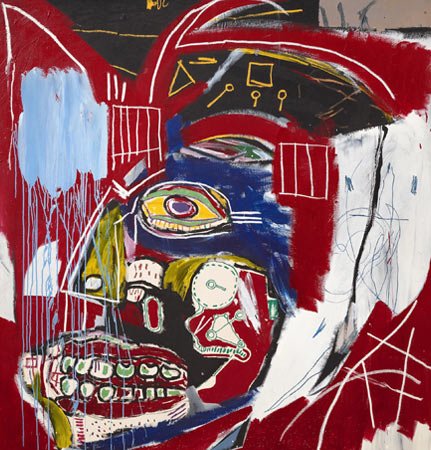
“In This Case” is a striking piece that forms part of a triptych featuring massive skulls. Created during the 1980s, this artwork showcases Basquiat’s distinctive approach to social themes and urban expression.
The intensity of the painting is amplified through its dynamic imagery and powerful symbolism. Sold at Christie’s New York in May 2021 for an astonishing $93.1 million, “In This Case” symbolizes Basquiat’s continued relevance in the art world.
This record-breaking sale reinforces the painting’s cultural significance and artistic prowess. Displayed alongside works like “Untitled” from 1981 and 1982, this triptych provides a deep dive into the emotional depth and social commentary pervasive in Basquiat’s art.
6. La Hara
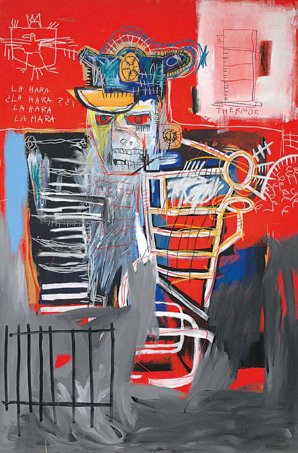
La Hara represents a significant piece in Jean-Michel Basquiat’s body of work. This artwork features a skeleton policeman behind bars, illustrating a powerful role reversal that addresses themes of systemic racism.
The title plays on the Puerto Rican slang term for “cop,” which adds layers of cultural context. Sold for $35 million at Christie’s in 2017, La Hara emphasizes the urgency and depth of Basquiat’s social commentary.
His representation of urban violence and cultural identity remains relevant today. Through this piece, viewers can engage with the complex realities that Basquiat confronted in his life and work.
7. Untitled (Boxer)
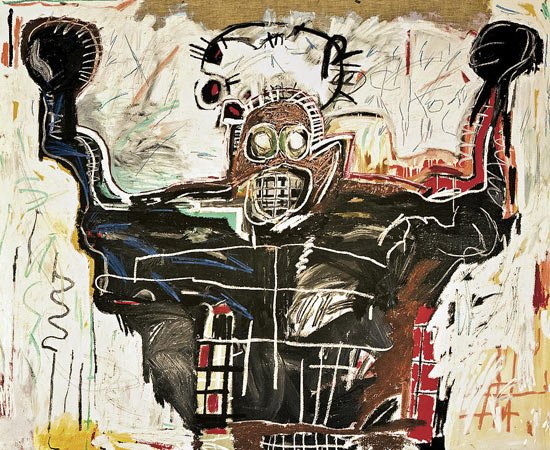
“Untitled (Boxer)” showcases an athlete haloed as if canonized, reflecting Basquiat’s admiration for figures like Sugar Ray Leonard and Cassius Clay.
This 2022 piece portrays the boxer as a powerful symbol of triumph over racism and social injustice. The dynamic lines and vibrant colors highlight the boxer’s muscular form, celebrating both strength and resilience.
By intertwining elements from popular culture and African-American history, Basquiat creates a self-portrait of sorts, capturing his own struggles in a predominantly white art world.
Auctioned for a staggering $135 million in May 2008, this painting underscores its importance within Basquiat’s oeuvre and contemporary art.
8. Hollywood Africans
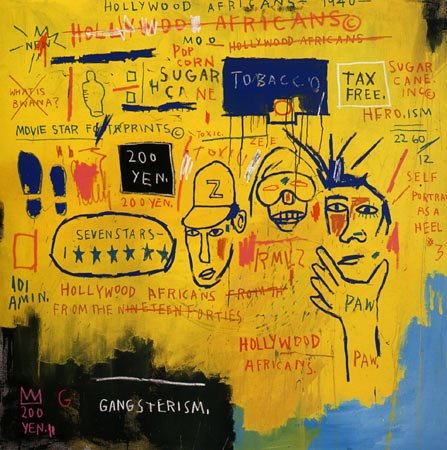
“Hollywood Africans” is a powerful painting by Jean-Michel Basquiat created in 1983. This artwork critiques the racial stereotypes imposed on African Americans by the entertainment industry.
It portrays Basquiat alongside rapper Rammellzee and painter Toxic, reflecting the artist’s personal experiences and struggles.
This piece incorporates autobiographical elements, like Basquiat’s birthdate digits, while also referencing historical themes such as Sugar Cane and Gangsterism.
The intentional crossing out of words emphasizes the issues of exclusion faced by Black performers in Hollywood.
Rich colors and bold imagery align with Basquiat’s neo-expressionist style, merging personal commentary with broader social issues.
In 2018, “Hollywood Africans” sold for a staggering $108 million, marking its significance not just as art but also as a meaningful cultural statement.
9. Charles the First
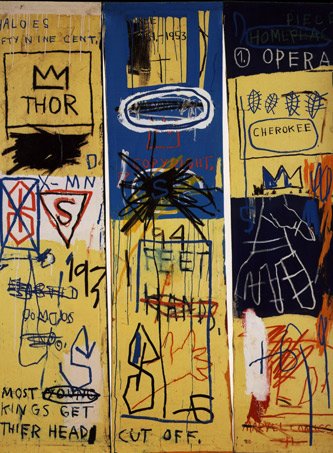
“Charles the First” stands out as a poignant tribute to Jean-Michel Basquiat’s admiration for African American cultural icons.
This iconic piece, crafted in 1982, serves as a dramatic commentary on race and identity. Vivid colors and aggressive lines depict a crowned figure, symbolizing both royalty and the struggles faced by Black individuals.
Sold for an impressive $21.9 million at Sotheby’s in 2017, the painting solidified Basquiat’s legacy as a master of merging complex social themes with striking visuals.
Each element in “Charles the First” resonates with his unique ability to channel raw emotion into compelling art.
The work continues to evoke discussions surrounding the historical and cultural significance of African American figures, emphasizing Basquiat’s role as a leading voice in contemporary art.
10. Irony of Black Policeman
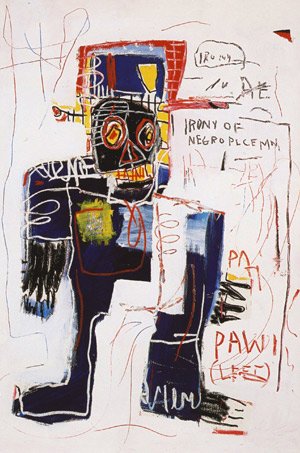
“Irony of a Negro Policeman” stands out as a compelling reflection on race dynamics in America. The artwork features a striking black figure, its masklike face and cage-like headgear represent the oppression African Americans face.
Basquiat’s inscription, “Irony of Negro Policeman,” boldly critiques the role of Black officers upholding a system that marginalizes their community.
The term “Pawn” at the bottom further emphasizes this critique, highlighting how these individuals are caught within conflicting identities.
This profound piece challenges viewers to grapple with systemic oppression while showcasing Basquiat’s unique ability to provoke introspection through art.


