
Russian painting boasts a rich tapestry of history, reflecting the nation’s cultural evolution and artistic prowess.
From the serene Orthodox icons of Andrei Rublev to the bold expressions of the avant-garde, each era has left an indelible mark on the world of art.
Iconic works have emerged from the depths of realism, capturing the essence of Russian identity through landscapes and portraits that resonate with both beauty and social commentary.
As we delve into the ten most famous Russian paintings, we’ll explore masterpieces that not only showcase artistic skill but also tell stories of a nation’s soul.
These works highlight the diversity of Russian art, revealing the unique perspectives of renowned artists like Ilya Repin and Kazimir Malevich.
Join in this visual journey through time, and discover the masterpieces that continue to inspire and captivate audiences around the globe.
1. Composition VII – Wassily Kandinsky

Composition VII, created in 1913, stands out as one of Wassily Kandinsky’s most renowned works. This painting showcases a mesmerizing blend of colors and dynamic forms, reflecting the artist’s exploration of abstraction.
Kandinsky aimed to evoke emotion through visual language, using swirling shapes and bold contrasts to guide the viewer’s eye.
It’s celebrated for its complexity and energy, marking a pivotal moment in the evolution of modern art. Through this work, Kandinsky solidified his status as a pioneering figure in abstract expressionism.
2. The Ninth Wave – Ivan Aivazovsky

The Ninth Wave, measuring 221×332 cm, depicts a dramatic scene of survival against a stormy sea. Aivazovsky masterfully uses light and color, showcasing a ship battling towering waves with hope shining through the rising sun.
The painting symbolizes both danger and resilience, becoming iconic in Russian art. Tretyakov acquired this masterpiece for 4,000 rubles, reflecting its significant value.
The work has transcended its origins, featuring in mass culture on candy wrappers, postage stamps, and even literature, cementing its place in Russian heritage.
3. The Last Day of Pompeii– Karl Briullov

Briullov painted “The Last Day of Pompeii” between 1830 and 1833, showcasing the terror of the volcanic eruption of Mount Vesuvius. The painting features vivid details, capturing the panic and desperation of the Pompeiians.
Critics praised Briullov for his realistic portrayal of human emotion and the dramatic atmosphere. Measuring an impressive 4.5 by 6.5 meters, this monumental work won the Grand Prix at the Paris Exhibition, establishing Briullov’s reputation across Europe and Russia. It’s regarded as a quintessential example of Romanticism in Russian art.
4. Volga Boatmen – Ilya Repin

Ilya Repin’s “Volga Boatmen,” painted between 1870 and 1873, illustrates the arduous lives of Russian laborers. Measuring 181 x 282 cm, this masterpiece depicts a group of weary men hauling a barge along the Volga River.
Repin’s keen attention to detail captures the men’s exhaustion and resilience, serving as a poignant commentary on social realism.
The painting became emblematic of the struggles faced by the working class in 19th-century Russia, solidifying Repin’s reputation as a leading figure in Russian art history.
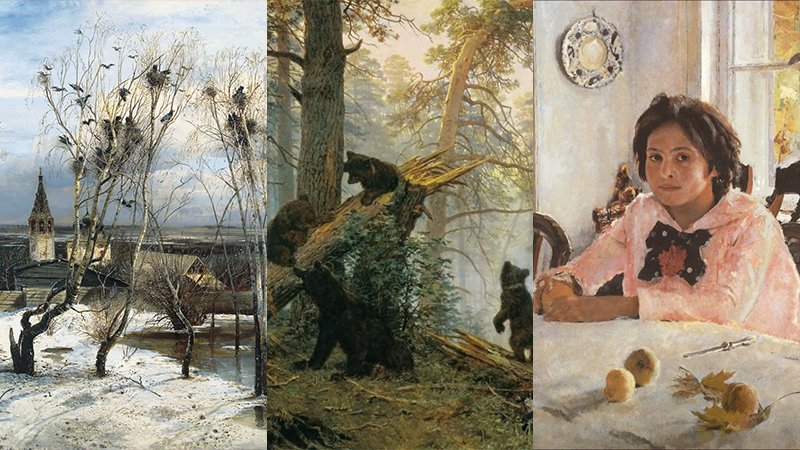
5. Girl with Peaches – Valentin Serov

“Girl with Peaches,” painted by Valentin Serov in 1887, features a 12-year-old girl named Vera Mamontova, who embodies youth and vitality. The painting showcases Serov’s impressionist style with brushstrokes and bold colors, capturing the playful essence of childhood.
Positioned against a lush background, Vera’s relaxed pose and the soft light create a sense of warmth and intimacy.
This work holds a significant place in Russian art history, reflecting Serov’s mastery of psychological portraits and his innovative approach that introduced impressionism to a predominantly realist era.
6. The Rooks Have Come Back – Aleksey Savrasov

Aleksey Savrasov painted “The Rooks Have Come Back” in 1871 to herald the arrival of spring. This landscape artwork features a serene scene where rooks return to their nests after winter, symbolizing renewal and hope.
Savrasov’s detailed brushwork captures the transition from icy landscapes to blossoming life.
This painting is often studied in Russian schools, sparking discussions on nature’s beauty and the changing seasons. Through its simplicity, it resonates with viewers, making it a staple in Russian art history.
7. La Mariee – Marc Chagall

“La Mariee,” painted by Marc Chagall in 1910, beautifully captures the essence of love and joy. The artwork features a whimsical bride floating amidst a world, representing hope and celebration.
Chagall’s signature use of bold colors and dreamlike imagery reflects his unique blend of realism and fantasy. The painting exemplifies his exploration of Eastern European Jewish themes and is characterized by its playful, surreal elements.
“La Mariee” remains an iconic masterpiece, showcasing Chagall’s innovative contribution to modern art and his deep emotional connection to his heritage.
8. The Black Square – Kazimir Malevich

Kazimir Malevich’s “The Black Square,” created in 1915, stands as a pivotal work in modern art. The painting features a simple black square on a white background, symbolizing the principles of Suprematism, which prioritizes geometric forms over representational art.
Forensic studies reveal layers beneath the surface, including Malevich’s fingerprints, showcasing the painting’s complex history.
Widely debated, it challenges viewers’ perceptions and expresses freedom from traditional artistic constraints, marking a revolutionary moment in Russian avant-garde art.
9. Trinity – Andrei Rublev

Andrei Rublev’s “Trinity,” painted in 1425, epitomizes the pinnacle of Russian Orthodox iconography. This masterpiece depicts the Holy Trinity through the serene faces of three angels, representing God, Jesus, and the Holy Spirit.
Rublev’s use of colors and harmonious composition creates a sense of divine peace. Revered for its spiritual significance, “Trinity” remains a standard for Orthodox icon painting, influencing generations of artists.
Rublev’s work transcends time, embodying the essence of Russian religious art and earning its place among the most famous paintings in history.
10. Morning in a Pine Forest – Ivan Shishkin

Morning in a Pine Forest, painted in 1889, showcases Shishkin’s exceptional ability to capture the tranquility of nature. The artwork features a family of bears amidst towering pines, illuminated by soft morning light.
Shishkin’s attention to detail and realistic portrayal of foliage highlight the beauty of the Russian landscape.
This iconic piece gained immense popularity, becoming synonymous with Russian art. Its serene portrayal of wildlife and nature continues to resonate with viewers, making it a staple in the art world and educational contexts.


