
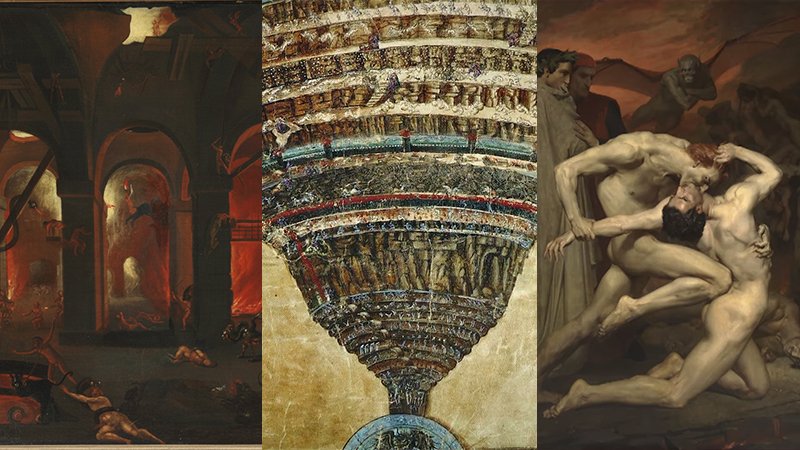
Throughout art history, the concept of hell has captivated artists and audiences alike, inspiring some of the most haunting and thought-provoking works.
From the fiery depths of Dante’s Inferno to the chaotic visions of Hieronymus Bosch, these paintings often serve as moral warnings about the consequences of sin.
The vivid imagery and intricate details draw viewers into a world of torment and despair, leaving lasting impressions that resonate through time.
In exploring the ten most famous hell paintings, one uncovers a rich tapestry of creativity and commentary. Each piece reflects the artist’s unique perspective on sin, redemption, and the human condition.
Whether it’s Michelangelo’s imposing fresco in the Sistine Chapel or Bosch’s surreal landscapes, these masterpieces not only depict suffering but also challenge viewers to confront their own beliefs about morality and the afterlife.
1. Hell – Hieronymus Bosch

Hieronymus Bosch’s Hell (circa 1490) is a striking depiction of damnation, part of a four-panel series illustrating humanity’s ascent to heaven and descent into hell.
The painting showcases a grotesque landscape filled with tormented souls suffering unique forms of punishment tailored to their sins.
Greed is represented by the cruel pulling of melted gold coins down the throats of the greedy, while the wrathful are seen endlessly battling each other.
At the scene’s core, Lucifer feasts on human bodies, symbolizing the ultimate consequence of sin. Bosch’s vision immerses viewers in a chaotic, dark cave, serving as a haunting reminder of moral teachings.
2. Dulle Griet – Pieter Bruegel the Elder

Dulle Griet, painted by Pieter Bruegel the Elder in 1563, stands as a striking exploration of hell through a unique lens.
This artwork features Mad Meg, a fierce woman leading a band of female warriors on a quest to conquer hell. Bruegel’s hellscape is depicted as a vast expanse, characterized by a reddish-black sky and hills teeming with chaos.
Mad Meg wields a sword in one hand while clutching a sack of plundered goods in the other, challenging the traditional portrayals of female figures in art.
Through this bold narrative, Bruegel critiques societal norms and introduces a powerful female archetype into the realm of the damned.
3. Pandemonium – John Martin

John Martin’s Pandemonium, painted in 1841, offers a breathtaking vision of hell inspired by John Milton’s Paradise Lost.
This depiction showcases a grand city, known as the High Capital of Satan, built in an hour with towering structures resembling London’s iconic buildings.
Martin portrays Satan commanding his legion of demons against a backdrop of fiery rivers and gold-tinted walls.
The intense contrast between light and dark reflects torment and chaos, captivating viewers as they witness this dramatic interpretation of eternal damnation.
4. Crucifixion and Last Judgement Diptych – Jan van Eyck

Jan van Eyck’s Crucifixion and Last Judgement Diptych stands as a seminal piece in the depiction of hell. Painted in 1440, this work features two dynamic panels.
The left panel portrays the Crucifixion, showcasing Jesus between two thieves, with onlookers witnessing the event.
A soldier pierces Jesus’ side, emphasizing the moment’s tragic gravity. The right panel contrasts sharply, illustrating the Last Judgement.
Here, souls ascend to heaven or plummet into hell, with demons torturing the damned, including notable figures like popes. This captivating diptych reflects the spiritual turmoil and moral lessons prevalent in the art of its time.
5. Satan Calling Up His Legions – William Blake

William Blake’s Satan Calling Up His Legions (1805) captures a powerful moment of despair and rebellion.
The artwork depicts Satan on a rocky crag, commanding his forces with an intense expression that resonates with the themes from John Milton’s Paradise Lost.
Blake’s swirling brushstrokes create an illusion of movement, illustrating the damned souls and demons swirling around Satan’s feet.
The vivid colors and dynamic composition immerse viewers in a nightmarish realm, highlighting the relentless struggle between good and evil, while also offering a poignant commentary on moral corruption.
6. The Haywain Triptych – Hieronymus Bosch

Bosch’s The Haywain Triptych (circa 1516) vividly illustrates the struggle between earthly desires and spiritual salvation. The left panel depicts creation, highlighting Adam and Eve’s fateful choice.
The central panel showcases humanity’s chaotic pursuit of pleasure, symbolized by a massive haywain, while the right panel presents a horrifying vision of hell, pulsating with tormented souls.
The figures, including the Wayfarer, navigate their path through life’s temptations, ultimately facing dire consequences. Bosch’s intricate details serve as moral warnings, inviting viewers to reflect on their own choices and the nature of sin.
7. Dante And Virgil – William-Adolphe Bouguereau

William-Adolphe Bouguereau’s Dante and Virgil (1850) captures a haunting moment from Dante’s Inferno. It depicts Dante and his guide Virgil witnessing a violent confrontation between two damned souls.
The scene vividly highlights the intense agony of sin, with Gianni Schicchi and Capocchio engaged in a brutal struggle. Bouguereau’s meticulous detail creates a striking emotional impact, emphasizing fear and despair.
The atmospheric composition and somber colors reinforce the horror of hell, inviting viewers to reflect on the consequences of moral transgressions in Dante’s epic narrative.
8. Inferno – Franz von Stuck

Franz von Stuck’s Inferno (1908) presents a haunting scene of eternal torment featuring five figures trapped in the depths of hell. Its dark palette and swirling brushstrokes create a yet harrowing atmosphere.
This powerful painting emphasizes the personal suffering of the damned, capturing their contorted bodies and anguished expressions. Notably, a female figure stands out with her glowing eyes, evoking pure fear.
The New York Times praised its raw brutality, cementing von Stuck’s legacy as a visionary artist exploring the depths of the human psyche.
9. The Map of Hell – Sandro Botticelli

Botticelli’s The Map of Hell, completed in 1485, intricately illustrates Dante’s vision of the inferno. This painting presents a unique funnel-like structure comprising nine distinct circles of hell, each reflecting a different sin.
Tiny yet meticulously detailed figures populate the layers, showcasing their varied, often subtle punishments. Unlike other hell depictions, Botticelli focuses more on the structure and emotional heaviness than horror.
His use of color and form evokes a sense of claustrophobia, compelling viewers to confront the eerie vastness of moral despair.
10. Dante And Virgil In The Underworld – Filippo Napoletano

Filippo Napoletano’s Dante And Virgil In The Underworld captures a pivotal moment from Dante’s Inferno. It showcases Dante and his guide Virgil observing a brutal struggle between two damned souls.
Napoletano employs dark tones to emphasize the terror of hell, making viewers feel the weight of despair surrounding the characters.
The intense expressions on the souls’ faces reflect their eternal torment, drawing on Dante’s vivid descriptions of punishment.
This artwork exemplifies the enduring influence of Dante’s work on artistic interpretations of the underworld, marrying vivid imagery with profound moral lessons.


