Cubism revolutionized the art world by breaking away from traditional perspectives and introducing a bold new visual language.
This avant-garde movement, pioneered by artists like Pablo Picasso and Georges Braque, portrayed subjects from multiple angles simultaneously using geometric shapes.
The result was a dynamic compression of space that challenged viewers to see beyond conventional representation.
Among the various themes Cubism explored, portraits stood out as a powerful way to blend abstraction with recognizable human forms.
These iconic Cubist portraits captured the essence of their subjects while pushing the boundaries of artistic expression.
1. Portrait of Picasso – Juan Gris

Juan Gris painted Portrait of Picasso in 1912, paying tribute to his mentor with sharp geometric shapes and bright color planes.
This work blends the background angles with Picasso’s face, flattening the composition and creating paradoxical spatial effects typical of Analytic Cubism.
Gris’s approach highlights his focus on structured forms and rich colors, setting the painting apart from Picasso’s more monochromatic style and showcasing his unique interpretation of Cubist portraiture.
2. Man with a Guitar – Georges Braque

Georges Braque’s Man with a Guitar (1912) epitomizes Analytic Cubism through fragmented geometric forms that depict a man engrossed in playing guitar.
Braque innovatively incorporated nails and ropes on canvas, adding tactile texture while breaking traditional space perception.
Measuring 116 x 80.9 cm, the monochromatic palette and subtle shading deepen volume and form. This masterpiece challenges visual reality, reflecting Braque’s mastery in redefining modern art and solidifying his pivotal role in Cubism’s evolution.
3. Cubist Self-Portrait, 1923 – Salvador Dali

Salvador Dali’s Cubist Self-Portrait (1923) showcases his early exploration of Cubism, presenting his visage as fragmented, mirror-like shards. He combines multiple angles and perspectives, reflecting the complexity of his identity.
Critics note his incorporation of African tribal art elements, enhancing the work’s cultural depth. This painting bridges Dali’s Surrealist fame with Cubist experimentation, making it a key piece in understanding Cubism’s influence on 20th-century avant-garde art.
4. Portrait of Wilhelm Uhde – Pablo Picasso

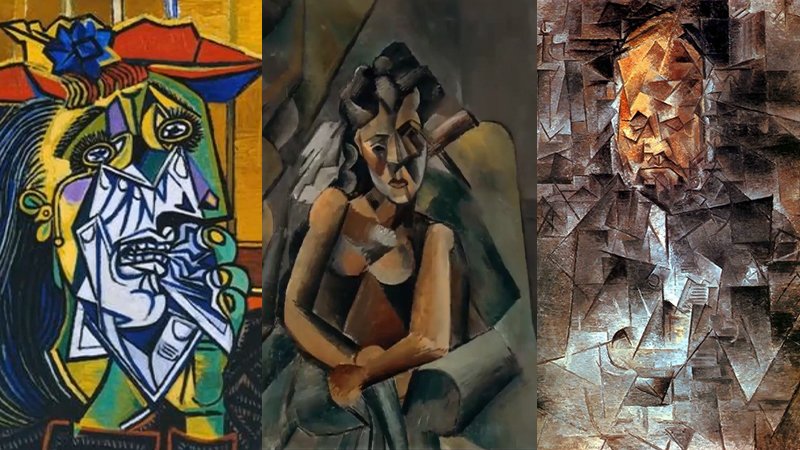
Pablo Picasso’s 1910 Portrait of Wilhelm Uhde exemplifies Cubism’s breakthrough by depicting the art collector in fragmented, shaded geometric shapes. Picasso compressed multiple angles into one view while keeping Uhde’s figure identifiable.
This innovative approach challenged traditional portraiture by combining abstraction with clarity. The painting highlights Picasso’s skill in blending complex spatial forms and maintaining the subject’s presence, reaffirming Cubism’s power to transform how viewers perceive the human figure.
5. Portrait of Madame Metzinger – Jean Metzinger

Jean Metzinger’s Portrait of Madame Metzinger (1911) stands out with its dark palette and structured Cubist style.
The painting blends geometric planes with muted tones, characteristic of early Cubism, to depict Madame Metzinger with subtle emotion. Metzinger’s Renaissance man reputation shines through his precise, poetic approach.
This portrait balances abstraction and recognition, capturing the sitter’s essence while advancing Cubism’s fragmented, multi-angle vision.
6. The Weeping Woman – Pablo Picasso

Pablo Picasso’s The Weeping Woman (1937) captures raw emotion through fragmented, angular forms and a yet somber palette. Painted shortly after Guernica, it reflects the anguish caused by the Spanish Civil War.
Picasso’s trademark profile view combined with contrasting geometric shapes portrays intense sorrow, emphasized by the faint blue tears on her face.
This powerful Cubist portrait symbolizes personal and collective suffering, showcasing Picasso’s mastery in using form and color to express deep emotional truth. The painting is prominently displayed at Tate Modern, London.
7. Head Of A Woman, 1909 – Georges Braque

Georges Braque’s Head of a Woman (1909) marks an early Cubist exploration of the female form, blending geometric shapes with dark blues and blacks to create mystery.
Painted soon after art school, it reflects Braque’s evolving style and strong ties to Picasso’s Cubism. The portrait distills the woman’s face and hair into elongated, abstracted shapes that capture multiple angles simultaneously.
This work stands as a foundational piece in Braque’s series depicting the human figure through Cubist principles, emphasizing form fragmentation and spatial compression.
8. Femme Assise, 1909 – Pablo Picasso

Femme Assise showcases Picasso’s early shift into Cubism by fragmenting the female form into interlocking geometric planes. He captures multiple perspectives simultaneously, distorting traditional portraiture while maintaining human recognition.
The muted palette of earthy browns and grays emphasizes volume and depth through subtle shading.
This work reflects Picasso’s experimentation with spatial compression and abstraction, marking a significant moment in Cubist portrait evolution. It highlights his innovative approach to representing the human figure beyond mere visual likeness.
9. Portrait of Josette, 1916 – Juan Gris

Juan Gris’s Portrait of Josette (1916) marks a key moment in Synthetic Cubism. He used rounded shapes and overlapping planes to depict Josette, his muse, seated with folded legs and clasped hands.
Gris applied mostly black and white tones, emphasizing structure over color, influenced by Cézanne and Corot.
This portrait exemplifies his shift from Analytical to Synthetic Cubism, showcasing multi-dimensionality and spatial complexity in human form representation.
10. Portrait de Ambroise Vollard – Pablo Picasso

Pablo Picasso’s Portrait de Ambroise Vollard (1910) exemplifies Cubism’s innovative approach to portraiture.
Picasso breaks down the art dealer’s face into fractured geometric shapes, compressing multiple viewpoints into a complex, multi-dimensional form.
Using muted earth tones and sharp angular planes, Picasso balances abstraction with recognizable human features.
This piece highlights Cubism’s shift from traditional realism to a fragmented, analytical style, reinforcing Vollard’s influential role in promoting avant-garde art. The work remains a key example of Cubist portraiture’s challenge to conventional representation.