
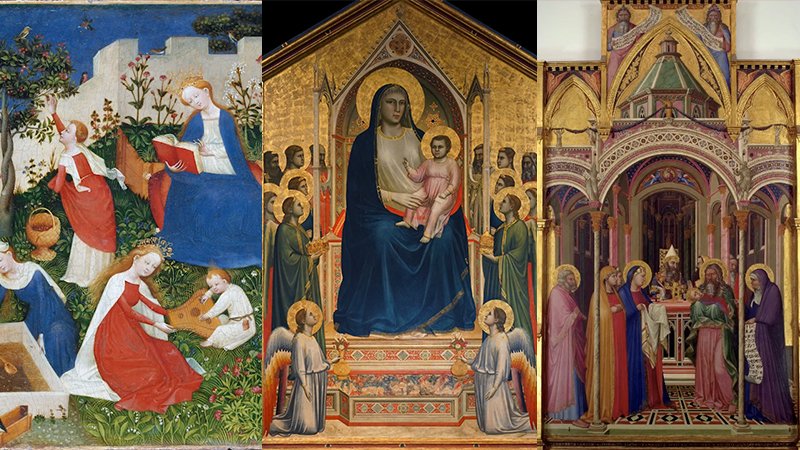
Medieval paintings offer a captivating glimpse into a world where art and spirituality intertwined deeply.
Spanning from the 5th to the 15th century, this period produced works that not only reflected religious devotion but also showcased innovative techniques in light, shadow, and composition.
These paintings laid the groundwork for future artistic movements and continue to inspire admiration today.
From illuminated manuscripts to iconic frescoes, the diversity of medieval art reveals a rich cultural tapestry.
Many masterpieces from this era, including some of the most famous religious scenes, have left an indelible mark on art history.
Exploring these 10 renowned medieval paintings provides a window into the creativity and devotion that defined an era of transformation and artistic exploration.
1. Lamentation (The Mourning of Christ) – Giotto Di Bondone

Created in 1306, Giotto’s Lamentation (The Mourning of Christ) is a defining medieval fresco located in Padua’s Scrovegni Chapel.
This poignant work captures the moments after Christ’s crucifixion, showing Mary and disciples mourning his lifeless body.
Giotto’s realistic expressions and use of depth mark a shift toward the Renaissance, influencing countless artists.
The fresco measures 200 cm by 185 cm and showcases angels grieving alongside human figures, emphasizing the emotional gravity of the scene. This masterpiece remains a cornerstone of Christian medieval art.
2. Wilton Diptych
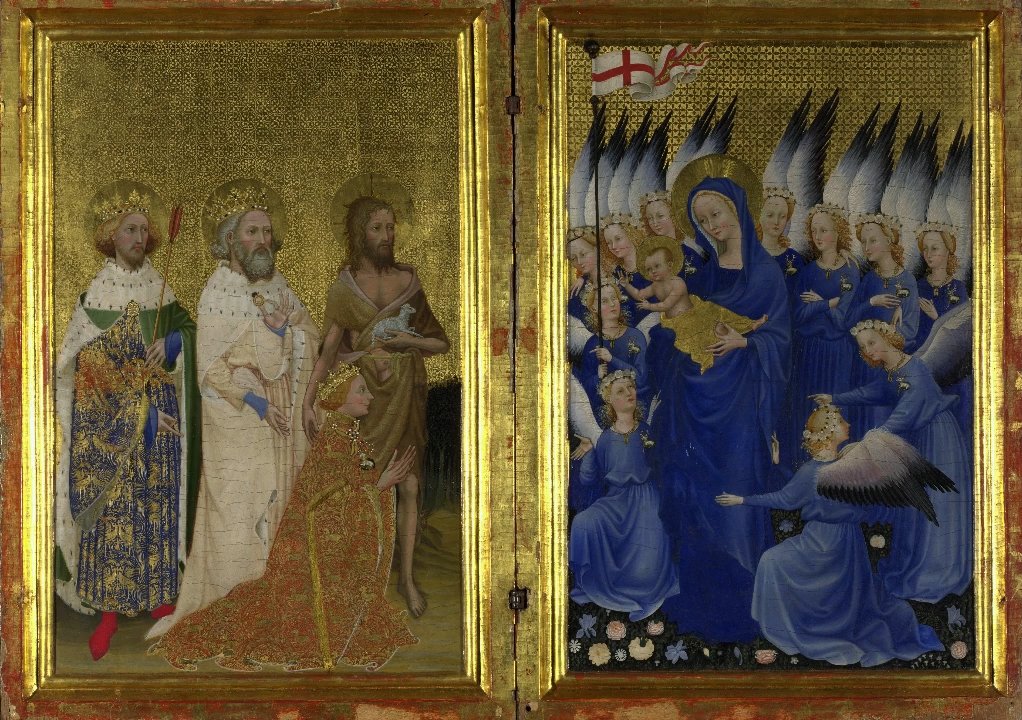
The Wilton Diptych is a rare English panel painting from the late Medieval period, housed in the National Gallery, London.
Painted in the International Gothic style, it features exquisite detail with small-scale figures, delicate facial features, and richly colored robes in gold and ultramarine blue.
The diptych includes symbolic elements like Saint George’s standard, the white hart badges of King Richard II, and rosemary flowers representing his first wife, Anne of Bohemia.
This two-panel altarpiece vividly portrays King Richard II kneeling before the Virgin Mary and Child, escorted by English saints.
3. The Ghent Altarpiece – Hubert and Jan van Eyck

The Ghent Altarpiece, crafted by brothers Hubert and Jan van Eyck in 1432, stands as the most stolen and celebrated medieval artwork.
This polyptych features 12 oil-painted panels depicting intricate biblical scenes from both the Old and New Testaments.
Housed in Saint Bavos Cathedral, Ghent, Belgium, its detailed realism and colors marked a key transition from medieval to Renaissance art.
The altarpiece’s central panel, the Adoration of the Mystic Lamb, symbolizes divine sacrifice, showcasing the van Eycks’ pioneering use of oil paint and masterful attention to detail.
4. The Presentation in the Temple – Ambrogio Lorenzetti

Ambrogio Lorenzetti’s The Presentation in the Temple exemplifies early 14th-century Sienese painting with its intricate detail and balanced composition.
The artwork portrays the biblical moment when Mary presents Jesus at the temple, capturing solemn expressions and delicate gestures.
Lorenzetti’s skillful use of tempera and gold leaf highlights religious symbolism, while his naturalistic figures signal a shift from Byzantine rigidity to more humanized forms in medieval art. This painting remains a key example of spiritual narrative blended with emerging artistic techniques.
5. Diptych of the Virgin and Child Enthroned and the Crucifixion
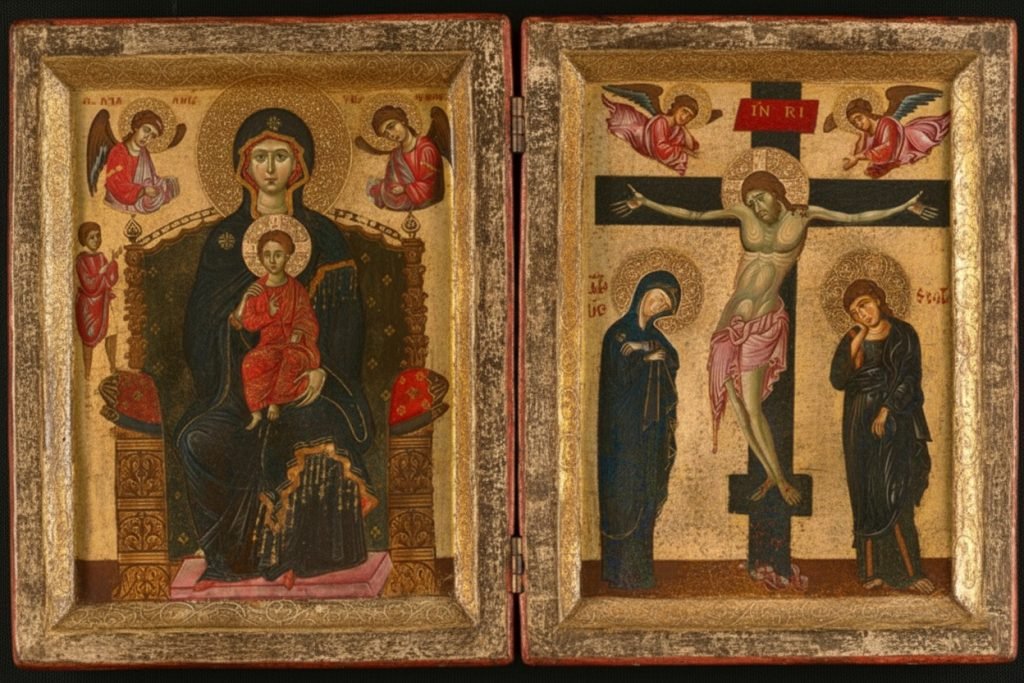
This diptych combines two hinged panels, each measuring 38 cm by 295 cm. The left panel portrays the Virgin Mary seated, holding the infant Jesus, accompanied by cherubs overhead.
The right panel depicts the crucifixion scene, with Jesus on the cross and two mourning women at his side. Angels watch from above, enhancing the spiritual intensity.
This simplistic yet powerful composition exemplifies early medieval religious art and highlights the era’s focus on devotional imagery. It remains a key example of diptych format and medieval panel painting.
6. The Trinity – Andrei Rublev

Andrei Rublev’s The Trinity is a pinnacle of medieval Russian art, painted between 1411 and 1427 with tempera on wood.
It depicts three angels symbolizing the Holy Trinity—God the Father, the Son, and the Holy Spirit—who visited Abraham to announce his wife’s pregnancy.
Measuring 142 cm by 114 cm, the icon showcases Rublev’s mastery of perspective, seen in the detailed building behind the left angel.
Housed in Moscow’s Tretyakov Gallery, The Trinity remains a profound spiritual and artistic masterpiece.
7. Ognissanti Madonna – Giotto di Bondone

Giotto’s Ognissanti Madonna (c. 1300–1305) stands as a landmark in medieval art, housed today in Florence’s Uffizi Gallery.
Painted as a large altarpiece for the Church of Ognissanti, it features the Virgin Mary enthroned, holding the Christ Child, surrounded by angels and saints.
Unlike the flat Byzantine style, Giotto gave Mary a monumental, sculptural presence and depicted Jesus as an old man to symbolize wisdom. This work marks a shift toward naturalism and volume that influenced Renaissance painting.
8. Rest During the Flight into Egypt – Gentile da Fabriano

Gentile da Fabriano’s “Rest During the Flight into Egypt,” painted in 1423, vividly portrays the Holy Family’s journey escaping King Herod’s massacre.
The expansive wood panel captures lush landscapes transitioning to a sprawling Egyptian city. The Virgin Mary, Joseph, and infant Jesus move slowly, surrounded by rich medieval detail and colors.
This work stands out for its delicate depiction of nature and architecture, showcasing the International Gothic style’s elegance while narrating a rarely painted biblical episode.
9. Paradiesgärtleins – Upper Rhenish Master

Paradiesgärtleins, meaning Garden of Paradise, is a vivid panel painting created around 1410 by the unknown Upper Rhenish Master.
The work depicts the Virgin Mary reading amid 24 plant and 12 bird species, surrounded by female saints and the infant Jesus playing a harp.
It showcases early attempts at naturalism through shading, roundness, and three-dimensional effects, especially in its trees and foliage.
This piece resides at Städel Museum in Frankfurt and stands as a rare medieval study of fauna and flora blended with religious themes.
10. Christ Rescuing Peter from Drowning – Lorenzo Veneziano

Lorenzo Veneziano painted “Christ Rescuing Peter from Drowning” in 1370, showcasing one of the New Testament’s most iconic miracles.
The panel painting, measuring 25 by 63 cm, captures Christ’s firm grip on Peter’s wrist as he walks on water amid a storm while disciples wait anxiously inside a fishing boat.
Housed in the Staatliche Museum Berlin, the work highlights Veneziano’s skill in realistic architecture and dynamic composition, contrasting calm faith with turbulent adversity to convey a powerful spiritual message.


