Pattern Description:
This scarf is crafted using twelve 6-inch granny squares based on the Large TOG Granny Square pattern, adaptable to any granny square design.
It features fall-inspired colors, though any color scheme can be used. The squares are joined using a whip stitch and then a crocheted border is added to finish the scarf, which measures 7.5″ by 78″.
Materials Needed & Measurements:
- Yarn: Bernat Premium yarn in Burgundy, Spring Green, Golden Wheat, Chili, and Caramel.
- Yarn Weight: Number 4 medium weight (worsted weight) yarn. Approximately 475 yards total are used for the scarf.
- Hook: 4.5 mm (7US), or 4mm (G-6US) crochet hook, or a hook size of your choice.
- Notions: Darning needle, Scissors, and an optional hand-steamer.
- Measurements:
- Individual granny squares: 6 inches in diameter.
- Finished scarf: 7.5 inches by 78 inches.
- Yarn usage: Approximately 30 yards per square and 35 yards per border round.
Stitches & Abbreviations Used:
- sc – single crochet
- ch – chain
- sk st – skip stitch
- ch1 sp – chain 1 space
- ch2 sp – chain 2 space
- ch3 sp – chain 3 space
- Whip stitch – a technique used for joining the granny squares, specifically in the top loops only (also called the back loops).
- Back loop and back bump – a method of crocheting into stitches for the border pattern.
Instructions for Making the Crochet Granny Square Scarf Pattern:
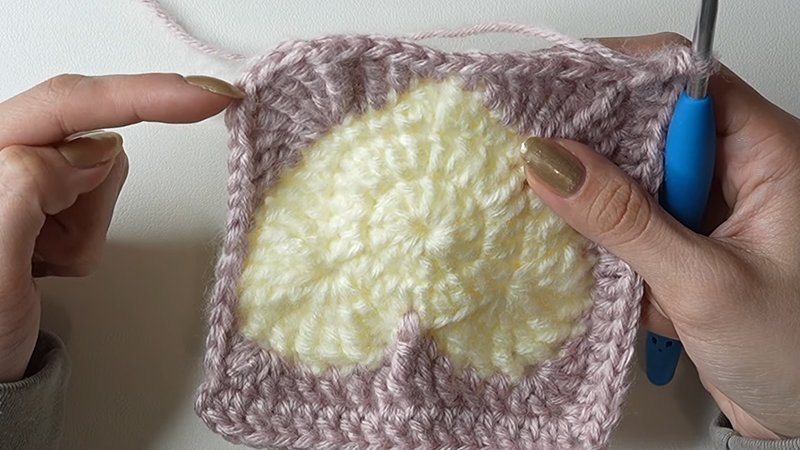
Here are the instructions for making the Crochet Granny Square Scarf pattern:
Step 1: Creating Your Granny Squares
- Crochet Twelve Granny Squares: You will need to crochet twelve granny squares in total. The pattern specifically uses the Large TOG Granny Square pattern, but you can substitute any granny square pattern you prefer. Each square should measure 6 inches in diameter.
- Color Combinations: Although five different fall colors are used in the example scarf, only four distinct color combinations are created for the granny squares themselves. The Caramel color is intentionally excluded from the last round of the granny squares to serve as a contrasting border color, which helps frame the different colored squares. When laying out your colors, it’s recommended to alternate dark and light colors to ensure a balanced visual effect and avoid grouping similar shades together.
- Blocking Squares: It is highly recommended to block your granny squares before joining them. An optional hand-steamer can be used for this purpose.
Step 2: Joining the Granny Squares (Whip Stitch Method)
Once your squares are complete and blocked, you will join them together. The recommended joining technique is the whip stitch, specifically worked in the top loops only (also referred to as the back loops), as this creates a “lovely frame” around each square.
Follow these steps to whip stitch your squares:
- Prepare Yarn: Cut a length of yarn that is three times the length of the granny square you are joining.
- Start Joining: Using the color of the upper square, join the yarn on the back of the square, leaving a small tail to darn in later.
- First Stitch: Bring your darning needle up through the back of the middle chain of the corner chain three space on the upper square, passing through only the top loop (the one facing the other square).
- Second Stitch: Then, bring the needle down into the lower square and pass it through the front of the top loop of the middle chain of its corner chain three.
- Continue Across: Bring the needle through the back of the top loop of the next stitch on the upper square. Then, come back down through the front of the top loop of the next stitch of the lower square and bring the needle up under the top loop of the upper square.
- Repeat: Continue to whip stitch the squares together in this manner until you reach the middle chain of the ch3 sp of the upper square.
- Last Stitch and Finishing: Your final stitch for that side will be made by going down into the middle chain of the ch3 sp of the lower square.
- Change Colors: Darn in your tail ends as you go. Remember to change your yarn color as you join new squares, using the color of the upper square you are currently working with.
Step 3: Crocheting the Border
After all your granny squares are sewn together, the final step is to crochet a border around the entire scarf. This border continues the “framing” look established by the whip-stitched squares by crocheting into the back loop and back bump of each stitch.
Here are the instructions for the border rounds:
- Round One (Caramel):
- Join into any stitch (working into the back loop and back bump) with a sc, then ch 1.
- Pattern Repeat: sk st, 1 sc, ch 1 in next st. Repeat from to corner.
- Corner: In the ch3 sp at the corner, make [1 sc, ch 2, 1 sc, ch 1].
- Continue Around: *sk st, 1 sc, ch 1 in next stitch. Repeat this stitch pattern along all four sides of the scarf, using the corner pattern as directed.
- Note: This first round can be “a bit tricky”. You will be working into the sides of the granny squares and sometimes into the whip stitch seam. Do your best to sk one stitch as you go, which might include skipping the whip stitch seam or crocheting into it. At the corners, you might need to ch 2 to reach the corner or make a single crochet just before it; adjust as needed.
- Round Two (Spring Green):
- Join into any ch1 sp with a sc, then ch 1.
- Pattern Repeat: sk st, 1 sc, ch 1 in the next ch1 sp. Repeat from to the corner.
- Corner: In the ch2 sp at the corner, make [1 sc, ch 2, 1 sc, ch 1].
- Continue Around: *sk st, 1 sc, ch 1 in the next ch1 sp. Repeat this stitch pattern along all four sides of the scarf, using the corner pattern as directed. This round is described as being “much easier” than Round One.
- Round Three (Chia):
- Repeat Round Two.
You have the option to repeat Round Two as often as you like, adding more colors or increasing the width of your border. The example scarf stops at three rounds.
Finishing Touches and Customization
Once your border is complete, ensure all your tail ends are neatly darned in. The pattern encourages customization and creativity: you can modify the scarf by using a different granny square pattern, making smaller squares, adding more rounds to the border, using a different color palette (perhaps just one color), or even adding tassels instead of a crocheted border.