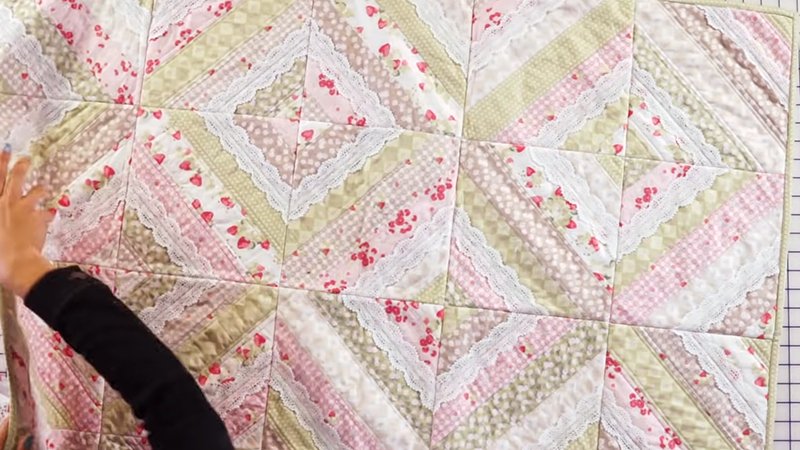
This Quilt As You Go (QAYG) Strip Quilt is fast and easy, making it perfect for beginners or quick projects.
By quilting as you go, the top, back, and quilting are completed together, leaving only the binding. It results in a reversible design.
Materials Needed & Measurements:
- Fabric Strips (2 1/2’’ x 42’’):
- 24 strips of fabric for the front of the quilt (center).
- 24 strips of fabric for the back of the quilt (center).
- 5 strips of fabric for the front of the quilt (border).
- 5 strips of fabric for the back of the quilt (border).
- 5 strips of fabric for the quilt binding.
- Note: If using pre-cut 2 1/2’’ wide jelly roll bundles, 2 jelly roll bundles are needed.
- Batting: You will need batting strips that are 42-44’’ long. Options include:
- 1 package of 2 1/4’’ wide pre-cut batting on a roll (some will be leftover). OR
- About 1 1/2 yards of 60”-wide batting (some will be leftover; this width lets you cut strips that are 42-45’’ long). OR
- A lot of batting scraps trimmed into 2 1/4’’ wide strips.
- The finished quilt size is approximately 45’’ x 50’’.
Instructions for Making the Quilt As You Go Strip Quilt Pattern:

Setting Up and Preparing the First Strip
To begin the Quilt As You Go process, we highly recommend using a walking foot on your sewing machine.
- Make Strip 1: Create a sandwich using one front-side strip, one back-side strip, and a strip of batting that is 42-44’’ long. Position the fabric strips so that their wrong sides are placed against the batting.
- Quilt Strip 1: Sew one or more lines of quilting along this assembled strip. The goal is to quilt these pieces together. You may choose different styles of quilting, such as a wavy line, straight lines, angled lines, or free motion quilting.
Attaching and Quilting Subsequent Strips
The following steps utilize the “sandwich method” to attach the remaining center strips (up to 24 strips total on the front and 24 strips on the back).
- Sewing Strip 2: Place a new back-side strip against the back of your existing quilted piece, ensuring the right sides are together. Similarly, place a new front-side strip against the front of the quilted piece, right sides together. Line up the edges on the right side.
- Adding Batting: Center a 42’’-44’’ strip of batting on the wrong side of the front-side strip.
- Stitch Together: Pin all 6 layers together and sew them with a $1/4’’$ seam allowance.
- Quilting Strip 2: Open up the front side strips and press (or finger press) the seam on the front. Flip the piece over and press (or finger press) the seam on the back. Pin the newly added strips together, making sure the batting is sandwiched in between the layers.
- Stitch the Quilt Line: From the back side of the quilt, sew one or more lines of quilting along the new strip.
- Continue Assembly: To add Strip 3 and beyond, repeat the process: add 2 more fabric strips (front and back) and one batting strip to the most recently sewn strips as described above. Pin and stitch using a $1/4’’$ seam allowance. Then, open the strips, press (or finger press), pin them together, and quilt as previously demonstrated. Continue these sewing and quilting steps until you have completed all 24 strips for the front and 24 strips for the back.
Trimming the Quilt Edges
Once the center strips are completed, the edges need to be squared up before adding borders.
- Fold for Trimming: It is easier to trim the sides if you fold the quilt in half horizontally.
- Trim Edges: Use a long ruler and a rotary cutter to even up the side edges of the quilt. This step also serves to trim away any selvages that may have been left on. The amount you need to trim may vary based on how evenly the strips were sewn.
Adding the Border Strips
The borders are added using the same QAYG sandwich method applied to the center strips.
- Determine Vertical Border Length: Measure the height of the quilt in the center. Note that the measurement may vary significantly depending on seam allowances and quilting. You have the option to add more strips at this point if you wish.
- Prepare Vertical Border Strips: Piece together 2 strips for the front border and 2 strips for the back border, matching the length of the quilt center you just measured. Cut batting strips to this length as well. Tip: You can sew together all 5 strips allocated for the front border and all 5 strips for the back border first, allowing you to cut all 4 necessary border pieces from these long strips.
- Attach Vertical Borders: Pin the side borders to the quilt. Use the same sandwich method as the center strips: place the back border strip against the edge on the back and the front border strip against the edge on the front, right sides together. Center the batting strip on the wrong side of the front border strip. Repeat this for the border on the opposite side of the quilt.
- Sew and Quilt Vertical Borders: Sew the vertical borders with a $1/4’’$ seam allowance. Open the border strips, press (or finger press), pin them together, and quilt.
- Determine Horizontal Border Length: Now measure the quilt horizontally across the center.
- Attach Horizontal Borders: Cut (or piece together) 2 strips for the front and 2 strips for the back that are the same length as the measured horizontal center. Cut batting strips to this length also. Sew the horizontal borders with a $1/4’’$ seam allowance.
- Quilt Horizontal Borders: Open the border strips, press (or finger press), pin them together, and quilt.
Sewing the Quilt Binding
The final step is to bind the finished quilt.
- Sew the 5 binding strips together.
- Bind your quilt using your preferred binding method.