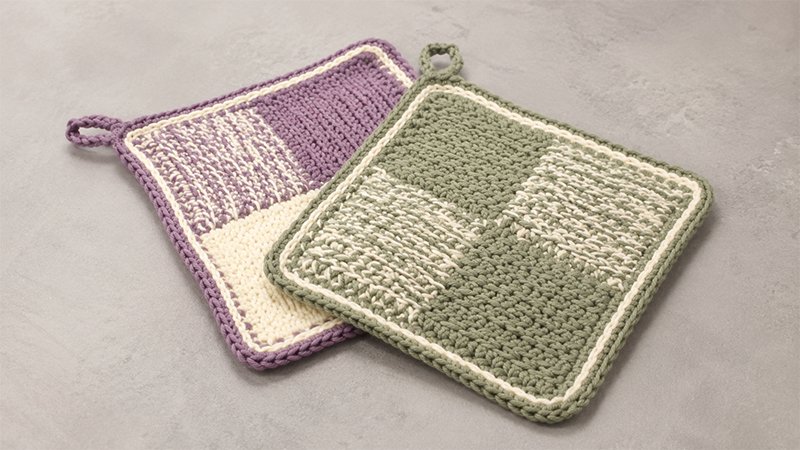
The Cottage Potholder uses Tunisian crochet to create a thick, durable, and highly textured fabric perfect for kitchen use. By combining two distinct vertical strips, alternating color strands, and using a unique twisted stitch technique, this project creates a beautiful woven effect.
A sturdy, multi-layered border adds structure, flattens the natural Tunisian curl, and includes a handy hanging loop.
Finished Dimensions: Approximately (). Gauge: () in the pattern stitch.
Tools and Supplies
-
Yarn: Light/DK weight cotton yarn () in two contrasting shades: Main Color (M) and Secondary Color (S). You will hold two strands together throughout the project.
-
Hooks:
-
(US L/11) Tunisian or standard straight crochet hook
-
(US K/10.5) standard crochet hook for the border
-
-
Notions: Yarn needle and scissors.
Abbreviations (US Terms)
-
Ch: Chain
-
Sc: Single crochet
-
Sk: Skip
-
Sl St: Slip stitch
-
St(s): Stitch(es)
-
Tss: Tunisian Simple Stitch
-
TssBL: Tunisian Simple Stitch in the Back Loop (detailed below)
-
Yo: Yarn over
Special Techniques
Standard Tunisian Return Pass
Yarn over and pull through the very first loop on your hook. Next, yarn over and pull through two loops. Repeat from * across the row until only a single loop remains on your hook.
Tunisian Simple Stitch in the Back Loop (TssBL)
This variation creates a twisted, textured rib.
-
Look at the next stitch. Instead of working under the front vertical bar, insert your hook from front to back through the space between the stitch you just completed and the next unworked stitch.
-
Maneuver the tip of your hook from right to left underneath the back vertical bar of that stitch.
-
Yarn over and pull up a loop.
Step-by-Step Pattern Instructions
Strip One
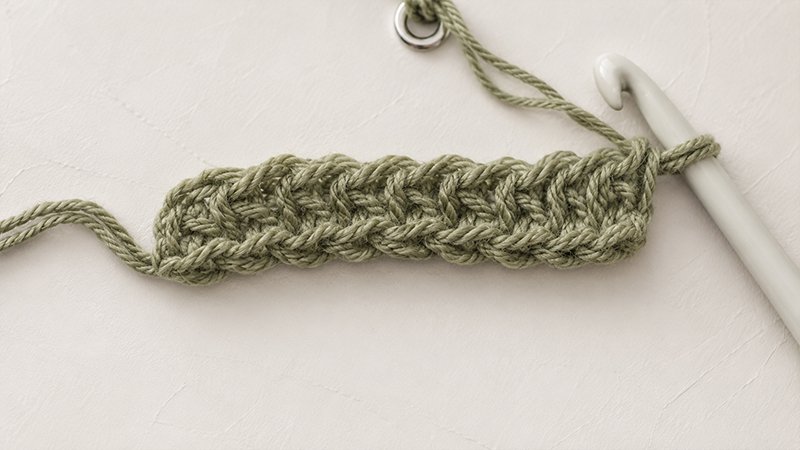
Use the 8.0-mm hook and hold two strands of Color M together.
-
Foundation Row: Ch 10. Turn the chain over and work into the back bumps. Insert your hook into the second chain from your hook, yarn over, and pull up a loop. Pull up a loop in each remaining chain across (). Complete a Standard Tunisian Return Pass.
-
Row 2 (Pattern Row): Skip the first vertical bar. Alternate stitches across the row by working (1 Tss, 1 TssBL) seven times total. For the final stitch, insert your hook under both outer edging loops of the last stitch from the row below. Complete a Standard Tunisian Return Pass.
-
Rows 3–8: Repeat Row 2.
-
Row 9 (Color Transition Row): Repeat the forward pass of Row 2. Begin your return pass normally. When only two loops remain on your hook, drop one strand of Color M and pick up one strand of Color S. Yarn over with this new combination (M + S) and pull through the final two loops.
-
Rows 10–18: Using the combined strands of M and S, repeat Row 2 nine times. Complete the final return pass normally.
-
Bind Off: Slip stitch into the front bar of each stitch across the row to close the fabric. Do not fasten off.
Strip Two
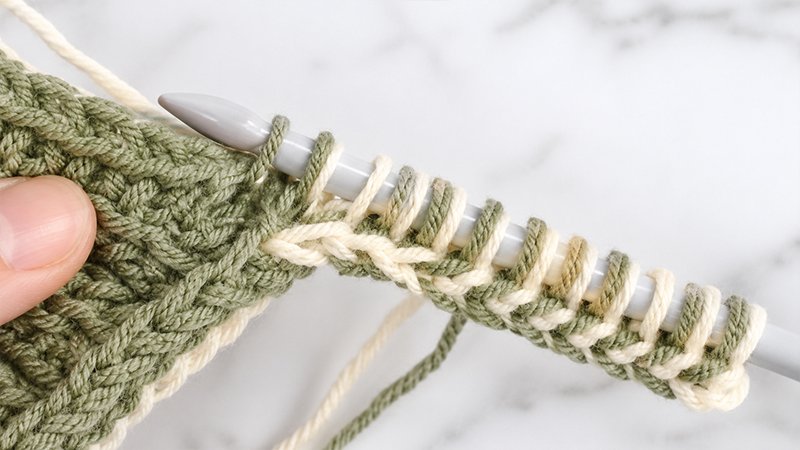
Use the 8.0-mm hook. You will join and build this strip directly onto the side of Strip One.
-
Foundation Row: Join one strand of M and one strand of S at the bottom-right corner of Strip One. Ch 10. Working into the back bumps of this new chain, pull up a loop from each chain. To secure this new strip to the first one, insert your hook into the edge chain of Row 1 on Strip One and make a slip stitch.
-
Return Pass: Yarn over and pull through two loops. Repeat this step 10 times until one loop remains.
-
-
Row 2 (Pattern Row & Joining): Skip the first stitch. Alternate (1 Tss, 1 TssBL) seven times across, then Tss into the last stitch. Slip stitch into the corresponding side edge chain of Strip One to anchor the row.
-
Return Pass: Yarn over and pull through two loops 10 times.
-
-
Rows 3–8: Repeat Row 2.
-
Row 9 (Color Transition Row): Repeat the forward pass and joining step of Row 2. Start the return pass by pulling through two loops 9 times. When two loops remain, drop the strand of Color S and pick up a second strand of Color M. Yarn over with the two strands of Color M and pull through the last two loops.
-
Rows 10–18: Using two strands of Color M, repeat Row 2 nine times.
-
Bind Off: Slip stitch into each stitch across to close. Secure the final slip stitch of Strip Two directly to the first slip stitch of Strip One’s top edge. Fasten off.
Adding the Border and Hanging Loop
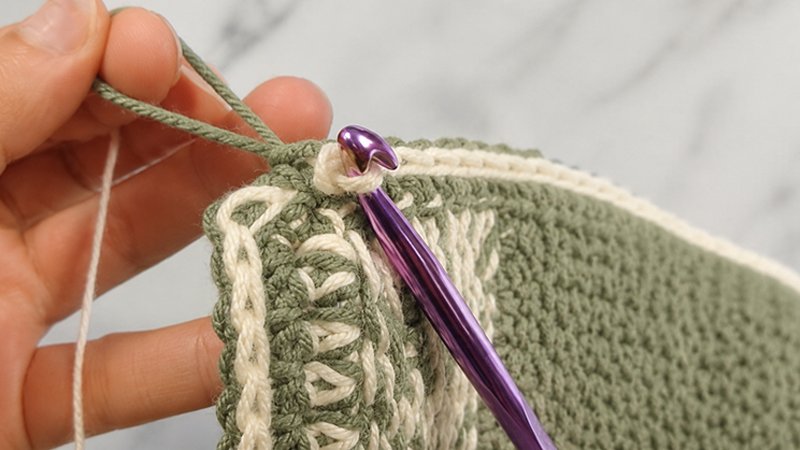
Switch to the 6.5-mm hook. Work with single strands.
-
Round 1 (Color M): Join Color M at any corner. Work 2 sc into each corner stitch, 1 sc into every standard stitch along the sides, and 1 sc in the indentation where the two strips meet. Join the end of the round with a slip stitch to your first sc. Drop Color M but do not cut it.
-
Round 2 (Color S): Join Color S into the first stitch of Round 1. Slip stitch evenly into every stitch around the entire perimeter. Fasten off Color S.
-
Round 3 (Color M & Hanging Loop): Pick up Color M again. Single crochet into every stitch around the edge. When you reach your preferred top corner, slip stitch to finish the round, then ch 10. Turn the potholder over, skip 1 stitch, and slip stitch into the next stitch to form a loop. Turn the work back to the front and work 1 slip stitch into each of the 10 chains to reinforce the loop. Fasten off.
Finishing Touches
-
Blocking and Straightening: Tunisian crochet naturally curls forward. To fix this, weave in your loose yarn ends in the exact direction of the curl. Weaving ends securely into the corners and outer edges acts as a natural structural support that pulls the edges flat.
-
Decorating: For a cozy, personalized look, you can sew small crochet appliqués (such as hearts, apples, or flowers) onto the front surface of the potholder.