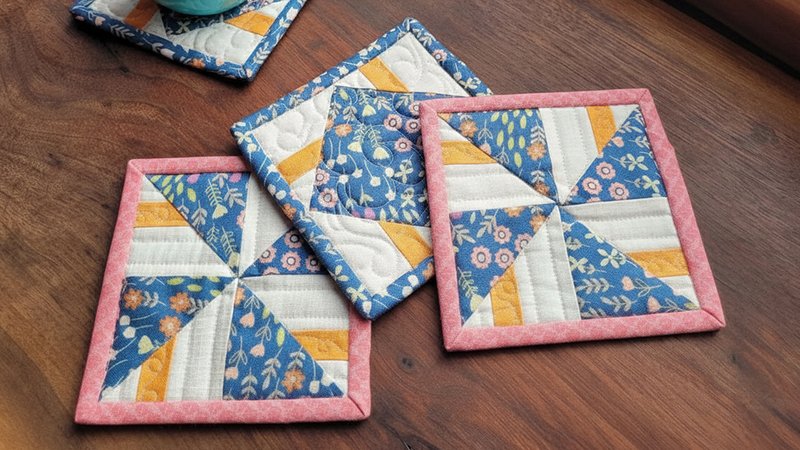
Pattern Description:
This is an easy-to-use pattern for creating DIY fabric coasters. The project utilizes a free downloadable PDF pattern to make quilted coasters that protect furniture from hot beverages and moisture.
The construction involves preparing fabric pieces (four main, two secondary), making a fabric sandwich with thick batting, stacking and pinning the layers, and then sewing and turning the coaster inside-out to finish. The process is described as a clever and creative idea with clear instructions.
Materials Needed & Measurements:
Materials Needed:
- Fabric: Two pieces of woven cotton (one main, one coordinating/secondary). It is advised to wash and iron the fabrics first to prevent later deformation.
- Thick Batting. A cotton/polyester mix or cotton batting may be used.
- Matching thread.
- Tools:
- Scissors (or rotary cutter and a cutting mat)
- Ruler or measuring tape
- Iron and ironing board
- Sewing clips or pins
- Sewing machine
Measurements/Seam Allowances:
- Pattern Printing: Print the free fabric coaster pattern in 100% size, with no scaling, using US letter paper or A4 paper.
- Optional Seam Allowance: An optional stitch around the fabric sandwich rectangle uses an eighth-inch seam allowance.
- Finishing Seam Allowance: When sewing all around the stacked layers, use a quarter-inch seam allowance.
Instructions for Making the Fabric coaster Pattern:
Step 1: Prepare the Fabric Coaster Pattern
The first step in this quilted coaster project is to obtain and prepare the pattern. You must download the free fabric coaster pattern, which is provided as a PDF file.
When printing the pattern, ensure that you print it in 100% size, with no scaling. The pattern can be printed on either US letter paper or A4 paper. Once printed, cut out the fabric coaster pattern, removing any excess paper.
Step 2: Cut Out the Fabric
Use the coaster template you just prepared as a guide to cut out the necessary fabric pieces.
The project uses two types of woven cotton fabric: one designated as “main” and one as “secondary” (coordinating).
It is important to wash the fabrics first and iron them well before cutting, as this prevents deformations later on when the finished coasters go through their first wash.
Using the template, cut out the following pieces:
- Four pieces of main fabric.
- Two pieces of secondary fabric.
- One piece of quilting batting.
A cotton/polyester mix or cotton batting can be used for this project.
Step 3: Make a Fabric Sandwich
This step involves layering the batting and two pieces of the main fabric to form a base.
- Place one piece of main fabric onto your workspace with its wrong side facing up.
- Put the batting piece on top of the fabric, ensuring the edges are aligned.
- Place a second main fabric piece on top of the batting layer, making sure this piece has its right side facing up.
- Align the edges of these three layers.
- Secure the layers together by pinning them or using sewing clips.
- To keep the batting secured in place, sew an X mark across the entire thing, starting the stitch lines at the corners.
- Optional: You may also sew around the sandwich rectangle with an eighth-inch seam allowance.
Step 4: Stack the Fabrics
This step involves layering the remaining fabric pieces, which have been folded.
- Take the remaining two pieces of main fabric and the two pieces of secondary fabric.
- Fold each of these four pieces in half with their wrong sides facing inward, and then press them flat with an iron.
- Take one piece of folded main fabric and place it on top of the fabric sandwich created in Step 3. The raw edge of this folded piece should be aligned with the bottom edge of the sandwich.
- Take one piece of folded secondary fabric and place it on top of the entire stack. Its raw edge must be aligned with the left edge of the sandwich and the previously placed main fabric.
- Take the second piece of folded main fabric and place it on top of all the layers, aligning its raw edge with the top edge of the stack.
- Place the last piece of folded secondary fabric on top. Align its raw edge with the stack’s right edge.
- Crucially, ensure you slide the bottom half of this last secondary fabric piece under the first folded main piece that was set onto the sandwich fabrics.
- Pin everything in place to secure all the stacked layers.
Step 5: Finish the Homemade Fabric Coasters
- Using a sewing machine, sew all around the stacked layers of fabric. You must use a quarter-inch seam allowance for this stitch.
- Cut the corners at an angle, taking care not to accidentally cut the thread.
- Turn the whole thing inside-out. This is done by pulling the fabric through the opening located at the center of the coaster.
- Use the back of a pencil or a chopstick to push out the corners so they are crisp.
- Press the coaster flat using your iron.
The homemade fabric coaster is now complete, providing a surface protected from wet rings.