Pattern Description:
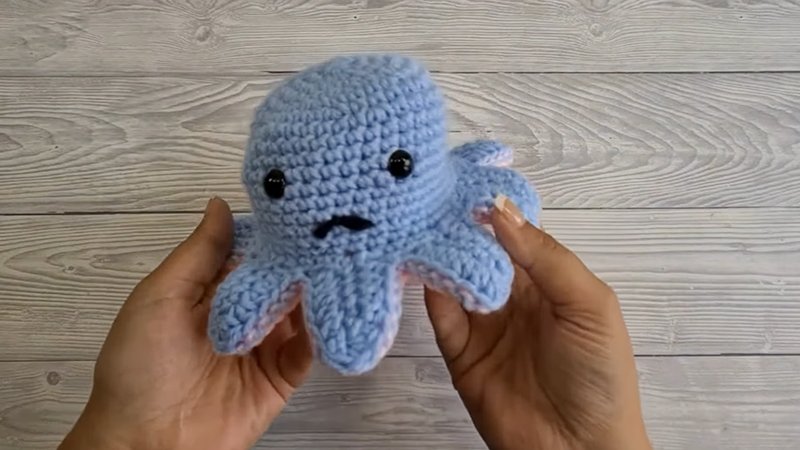
The reversible octopus plushie has become a popular craft project thanks to its playful ability to flip between two moods.
With just a few materials and some creativity, you can sew your own adorable mood octopus. Below is a detailed step-by-step guide that will help you bring this project to life.
Materials You Will Need:
Before getting started, gather the following supplies:
- Fabric: Around half a yard of two contrasting fabrics, such as fleece, minky, or felt. These give your octopus a soft, cuddly feel.
- Stuffing: Polyester fiberfill for plumpness. Hypoallergenic fiberfill is a great option.
- Sewing Tools: A sewing machine (or hand sewing needle if you prefer), scissors, pins, and matching thread.
- Marking Tools: Fabric chalk or a washable marker for tracing your templates.
- Templates: Free downloadable templates from the original YouTube tutorial by Isa’s World.
- Extras: A chopstick or similar tool for turning fabric, and acrylic paints (such as Decor Americana) for facial expressions.
Instructions for Making the Reversible Octopus Pattern:
Step 1: Preparing Your Template and Fabric

Begin by locating the free templates linked in Isa’s World’s tutorial. Print them at the recommended scale, then carefully cut out the paper shapes for the body and tentacles.
Next, fold your fabric so that the right sides are facing each other. Pin the template pieces onto the fabric, trace around them with fabric chalk, and cut them out.
You’ll need two body pieces in each color (four total) and multiple tentacle pieces, usually eight of each color.
Step 2: Sewing the Body and Tentacles

Take two matching body pieces (for example, both from your “happy” color) and pin them right sides together.
Sew along the curved edge, leaving a small gap of about 2–3 inches unstitched. Repeat this step with the other body pieces in your contrasting color.
For the tentacles, pair each set of fabric pieces and sew around the curved edge, leaving the straight top edge open.
Trim the seams and clip curves so they’ll look smooth once turned. Repeat this for all tentacles in both colors.
Now it’s time to join the halves. Keep both body sections inside out, line them up at the open edges, and sew them together. This seam creates the passage that allows the octopus to flip between moods.
If your template requires separate tentacles, turn them right side out and attach them to one of the body halves before you complete the final assembly.
Make sure they’re pinned with the tips pointing inward, so when you flip the octopus later, they stick out naturally.
Step 3: Adding the Face

One of the most enjoyable parts of the project is giving your octopus its personality. Use acrylic paints like Decor Americana to add eyes and mouths.
One side should carry a cheerful expression, while the other has a grumpy or sad face. Be sure to let the paint dry thoroughly before continuing.
If you’d prefer not to paint, you can embroider the features with thread or use small pieces of felt for appliqué. These methods create a softer or more textured look while still keeping the features secure.
Step 4: Turning and Stuffing

Through the opening left in the body, turn the entire plushie right side out. A chopstick or blunt pencil can help push out the seams neatly.
Next, stuff the body and tentacles with fiberfill. Distribute the stuffing evenly so the octopus feels soft but not lumpy. Avoid overstuffing, as this can distort the shape.
When you’re happy with the plumpness, close the opening using a ladder stitch or another invisible hand stitch. This creates a neat finish without obvious seams.
Step 5: Personalization

Once the base plushie is complete, you can add unique touches to make it your own. Consider experimenting with fabric patterns like tie-dye, glitter fleece, or polka dots.
Embroidered embellishments such as stars, eyelashes, or small hearts can also give your octopus more charm.
While most people choose happy and grumpy faces, don’t feel limited, your octopus could be sleepy, surprised, mischievous, or even silly. The reversible design makes it a perfect emotional companion.
Creative Uses
A handmade reversible octopus isn’t just a fun craft, it’s also practical and meaningful. Place it on your desk as a mood indicator, gift it to a friend or child, or use it as a playful emotional tool.
Kids, in particular, love flipping the octopus to express how they feel without needing to say a word.
Final Thoughts
By following these steps, you’ll end up with a squishy, reversible octopus that’s both cute and expressive.
The project combines sewing, painting, and personalization, making it perfect for beginners and experienced crafters alike.