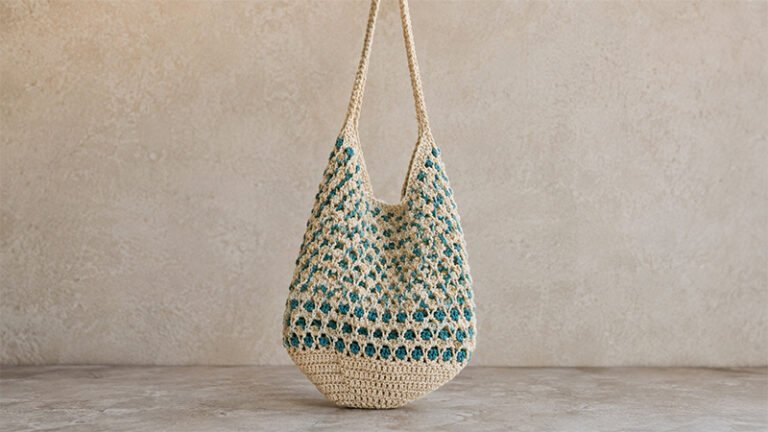
Materials Needed & Measurements:
- Suggested yarn:
- Rowan Felted Tweed
- Garnstudio DROPS Baby Merino
- Lana Grossa Cool Wool Merino Superfein
- Gazzal Baby Wool
- Yarn weight: DK (11 wpi)
- Gauge: 23 sts and 12 rows = 10 cm (double crochet/treble crochet)
- Hook size: 2.5 mm, 3.0 mm
- Yardage: 1837 – 2488 yards (1680 – 2275 m)
- Sizes available: XS-S/M-L
- Crochet terminology: Both US and UK
Abbreviations:
- ch – Chain
- sc – Single Crochet
- hdc – Half Double Crochet
- dc – Double Crochet
- tr – Treble Crochet
- dc2tog – Double Crochet 2 Together (decrease)
- BLO – Back Loop Only
- FLO – Front Loop Only
- V-stitch – 2 Double Crochets into the same space
- Shell – 5 Double Crochets worked into the same stitch or space
- tc – Turning Chain (often a chain of 3 for double crochet)
- sl st – Slip Stitch
Stitching Instructions of Helga Pattern:
Foundation Chain:
- Begin by creating a foundation chain of the specified number of stitches (ch). This chain will form the base of your project.
- For example, if the pattern says “ch 40,” you’ll make 40 chain stitches. Ensure your tension is consistent so your foundation chain lies flat.
- Turn your work after completing the foundation chain (unless stated otherwise).
- Depending on the pattern, the first row often begins with a certain type of stitch:
- For instance, “sc in 2nd ch from hook” means working a single crochet (sc) in the second chain from your hook.
- If the pattern specifies a different stitch, such as “hdc” (half double crochet) or “dc” (double crochet), follow those instructions instead.
- After finishing the first row, turn your work to start the next row. In most patterns, each row is worked in a back-and-forth motion unless working in rounds.
Stitching Technique:
- The pattern will specify the stitch you need to use for each row, with common abbreviations like:
- sc (single crochet)
- hdc (half double crochet)
- dc (double crochet)
- tr (treble crochet)
- dc2tog (double crochet 2 together, a decrease stitch)
- For example, a row might say “dc in each st across”—this means you’ll work a double crochet (dc) into each stitch across the row.
- Sometimes, patterns will specify working in a certain way:
- “Work in BLO” (Back Loop Only): Insert your hook into the back loop of each stitch.
- “Work in FLO” (Front Loop Only): Insert your hook into the front loop of each stitch.
- Special Stitches: Some patterns use special stitches like:
- V-stitch: This usually involves making 2 dc stitches into the same space.
- Shell: Often 5 dc stitches worked into the same stitch or space.
Pattern Repeats:
- Crochet patterns often have repeated sections or motifs. The instructions will tell you how many times to repeat a specific set of stitches across a row or in multiple rows.
- Example: “Repeat dc, ch 1 across the row.” Here, you’d work a double crochet (dc), then a chain stitch (ch 1), and repeat that across the row until you reach the end.
- Some patterns may also have a “turning chain” (tc) at the beginning of rows, such as “ch 3” to count as the first dc for the next row. These are common in dc-based patterns to maintain stitch height.
Increasing and Decreasing:
- Increasing means adding stitches to make the project wider or fuller.
- For instance, “2 dc in same st” means to make two double crochets (dc) into the same stitch, effectively increasing the stitch count.
- Increases could be done at the beginning, middle, or end of a row depending on the shaping required.
- Decreasing reduces the stitch count to shape the project.
- For example, “dc2tog” means working two double crochet stitches together in the same stitch (a decrease).
- To decrease over several rows, you might see a pattern that says “repeat dc2tog across,” indicating multiple decreases.
Finishing:
- Once the body of your project is complete, the pattern will guide you through finishing touches.
- Edging: Patterns often include a border around the edges, such as “sc around,” meaning you work single crochet (sc) stitches evenly around the perimeter of the item.
- Weaving in Ends: Use a yarn needle to weave in any loose ends, ensuring they’re secure and hidden in the project.
- Blocking: Sometimes, you’ll need to block your work to even out the stitches. This involves lightly wetting the project and pinning it to shape as it dries.
- Joining Pieces: If your project consists of multiple pieces, follow the instructions to join them together, often using whip stitch or slip stitch (sl st) to sew seams or edges.