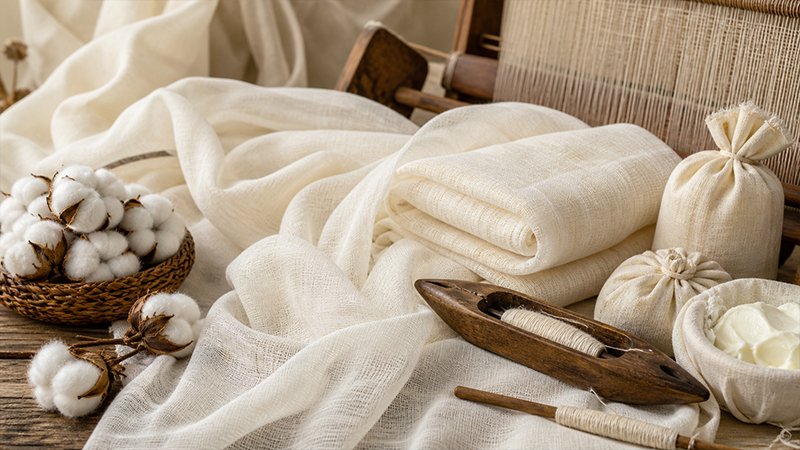
Muslin is a legendary plain-weave cotton fabric, celebrated for centuries as “woven air” and “evening dew”. Traditionally produced in Bengal, the most exquisite variety, Dhaka Muslin, was meticulously crafted from the endemic Phuti karpas plant using specialized artisanal techniques.
This “royal” textile achieved such unparalleled fineness that entire garments could purportedly pass through a finger ring.
Following its 18th-century decline due to colonial policies and industrial competition, a decade-long research initiative in Bangladesh successfully revived the craft, leading to its Geographical Indication (GI) status in 2020.
Today, muslin remains highly versatile, serving as a foundational medium for high fashion pattern making, professional photography backdrops, and essential culinary tools like butter muslin.
The Origins and Etymology of Muslin
The word “muslin” itself carries a global history. Most scholars believe the name originates from Mosul, a famous trading center in modern-day Iraq, where Europeans first encountered the fine cloth.
However, an alternative etymology traces the word to Masulipatnam, a prominent port on India’s Coromandel Coast that served as a major textile export hub.
While produced in various regions, the Bengal region—and specifically the area around Dhaka—became the world’s epicenter for the highest quality muslin.
By the 17th and 18th centuries, Mughal Bengal was the foremost exporter of muslin, with the fabric becoming a symbol of prestige in the luxury markets of Europe and the Middle East.
The Secret Science of Dhaka Muslin: How It Was Made
The legendary quality of Dhaka Muslin was not accidental; it was the result of a precise combination of biology and artisanal skill.
The Endemic “Phuti karpas.”
The foundation of the finest muslin was a unique species of cotton called Phuti karpas (Gossypium arboreum var. neglecta). This plant grew only in a specific microclimatic zone along the banks of the Shitalakshya River.
The river’s unique soil and humidity levels produced a cotton boll with exceptionally long, thin fibers ideal for high-count yarn.
Specialized Craftsmanship
The manufacturing process involved several highly specialized stages:
- Ginning with Fish Bones: Artisans used the jawbone of a catfish (boalee) to comb and clean the cotton fibers, removing seeds and impurities without damaging the delicate strands.
- The Humidity Factor: Weaving was often done during the rainy season because the high humidity increased the elasticity of the yarn, preventing it from snapping under tension.
- Elite Spinners: Yarn spinning was typically performed by young women under the age of 30, chosen for their nimble fingers and acute eyesight. It could take over five months to weave a single piece of the highest quality muslin.
The Thread Count Truth: Ancient vs. Modern
In the textile world, thread count refers to the number of vertical and horizontal threads per square inch.
- Ancient Standards: Historical records claim that the original Dhaka Muslin reached thread counts between 700 and 1500. These fabrics were so transparent that they were described as “garments of the wind”.
- Modern Realities: Due to the industrial revolution and the loss of original techniques, most modern commercial muslin ranges between 40 and 100 thread count.
- The Revival Achievement: Recent Bangladeshi restoration projects have successfully recreated muslin with a thread count of 300 to 500, a significant milestone in bringing back the “royal” quality.
The Tragic Decline of an Industry
The decline of the Bengal muslin industry was driven by a combination of political and economic shifts:
- Loss of Patronage: The fall of the Mughal Empire led to a decrease in demand for ultra-luxury goods.
- Industrial Revolution: In the late 18th century, English cotton mills introduced steam-powered spinning mules, which produced cheaper, mass-market fabrics that hand-woven muslin could not compete with in price.
- Colonial Suppression: Under British Company rule, high tariffs were placed on Indian exports, and policies were implemented to suppress local weaving in favor of British-produced cloth. There are even historical allegations (though debated by some) that the thumbs of master weavers were forcibly removed to prevent them from practicing their craft.
The Modern Renaissance: Restoring a Living Heritage
After nearly two centuries of being considered “extinct,” muslin is making a comeback.
The Restoration Project
In 2014, the Bangladesh government launched a project to revive the legendary fabric. Researchers spent years searching for the lost Phuti karpas plant, eventually finding a species with a 70% genetic match near Kapasia.
Recognition and GI Status
The revival efforts have been officially recognized:
- In 2013, the Jamdani weaving art (a type of muslin) was included in UNESCO’s list of Intangible Cultural Heritage.
- In 2020, Dhakai Muslin was officially recognized as a Geographical Indication (GI) product of Bangladesh.
- The Dhakai Muslin House was established in Tarabo, Narayanganj, to provide technical training to new generations of weavers.
Muslin in Modern Daily Life: Practical Uses
Beyond its historical prestige, muslin remains one of the most versatile fabrics used today.
Culinary Arts: Butter Muslin vs. Cheesecloth
In the kitchen, muslin is an essential tool for food production.
- Cheesecloth: A thin, loosely woven gauze-like cloth used to remove whey from cheese curds or bundle herbs for stocks.
- Butter Muslin: A much more tightly woven cloth (typically 90 thread count) used for draining soft cheeses like cream cheese and yogurt, or for producing homemade butter.
Photography and Set Design
Muslin is the preferred material for professional photography backdrops.
- Mottled Patterns: Abstract, hand-painted patterns help remove reflections and add depth to portraits.
- Portability: Muslin backdrops are lightweight and can be easily folded, making them ideal for on-location shoots.
Fashion and Pattern Making
In the garment industry, muslin is used to create “toiles” or test models. Because it is inexpensive, designers use it to perfect the fit and drape of a garment before cutting into expensive final fabrics.
Muslin vs. Gauze: Understanding the Difference
While muslin and gauze are often used interchangeably in casual conversation, they are distinct textiles with unique structural characteristics, histories, and practical applications.
The primary difference lies in their weaving technique and density, which dictate how they feel against the skin and how they perform in various environments.
Structural Differences: Weave and Texture
- Muslin: This is a plain-weave cotton fabric made with fine cotton yarns. It is constructed in a wide range of weights, from delicate sheers to coarse sheeting. The result is a smooth surface with a relatively tight weave that provides a “crisp hand feel” which softens with every wash.
- Gauze: In contrast, gauze is defined by its loose, open weave that creates a visible, subtle grid-like texture. It is often manufactured in double or triple layers to provide substance while maintaining its airy, lightly crinkled touch.
Breathability and Sensory Experience
The difference in construction leads to a distinct “feel” for each fabric:
- Muslin’s Density: Because it is slightly denser than gauze, muslin offers a cool and crisp touch. It is highly breathable, making it a classic choice for spring and summer loungewear or lightweight bedding.
- Gauze’s Loft: The “airy gaps” between the threads in gauze make it feel softer and fluffier. It is frequently described as having a “cloud-like drape” that is exceptionally gentle on sensitive skin, which is why it is preferred for cozy pajamas and baby quilts.
Durability and Maintenance
- Resilience: Muslin is known for its ability to hold its shape well and resist pilling over time. It is considered a durable, “structured” natural choice.
- Delicacy: Due to its open-weave structure, gauze is generally more delicate than muslin. However, modern double-gauze versions are engineered to be sturdier than they appear while remaining lightweight. Both fabrics are typically machine washable and quick-drying.
Primary Use Cases
The two fabrics serve different professional and domestic niches:
- Muslin’s Versatility: It is the industry standard for dressmaking test-models (toiles) because it is inexpensive and mimics the drape of final garments. It is also the preferred material for photography backdrops and theatre sets due to its ability to hold dyes and paint well. In the kitchen, specialized “butter muslin” (a tight 90-thread-count weave) is used for draining soft cheeses and yogurt.
- Gauze’s Specialization: Beyond apparel, gauze has a long history in medicine. Surgeons use “hydrophilic muslin” or gauze to wrap around intracranial vessels or aneurysms to provide reinforcement and prevent bleeding.
Summary Comparison Table
| Feature | Muslin | Gauze |
|---|---|---|
| Structure | Plain-weave, fine yarns | Open, loose, grid-like weave |
| Texture | Smooth and slightly crisp | Airy and lightly crinkled |
| Feel | Cool, structured, and crisp | Fluffy, soft, and “cloud-like” |
| Durability | High; holds shape and resists pilling | More delicate due to open gaps |
| Origins | Named after Mosul (Iraq) | Derived from the French word gaze |
Washing and Maintenance
To preserve the softness and longevity of muslin, proper care is vital.
- Washing: Always use a gentle cycle with cold water to prevent shrinkage. Mild, eco-friendly detergents are recommended, and bleach should be strictly avoided as it degrades natural cotton fibers.
- Drying: Air drying is the gold standard for muslin. If using a dryer, set it to low heat and remove the fabric while it is still slightly damp to prevent stiffness and deep-set wrinkles.
- Ironing: Use a low heat setting or a steam iron. For photography backdrops, a simple water spray can often help wrinkles fall out naturally when the fabric is hung.
- Storage: Store muslin in breathable cotton bags rather than plastic, which can trap moisture and lead to mildew.
Conclusion: The Future of a “Living Fossil.”
Muslin remains an enduring symbol of cultural resilience, bridging ancient artistry and modern industry. Once celebrated as “woven air” for its diaphanous quality, the legendary fabric faced near-extinction under colonial rule and industrialization.
However, the successful revival of Dhaka Muslin in Bangladesh has restored this “living fossil,” securing its Geographical Indication (GI) status in 2020.
Today, muslin’s legacy persists through high-fashion pattern making and specialized culinary tools like butter muslin. Its unique ability to adapt—from royal Mughal courts to professional photography backdrops—highlights its status as a timeless international asset.
Ultimately, the restoration of this artisanal practice ensures that the heritage of the Phuti karpas plant and the skill of local weavers will be preserved for future generations.