Net fabric is a lightweight, breathable textile made by weaving or knitting yarns in an open, mesh-like structure. It is commonly used in clothing, sportswear, curtains, bags, and industrial applications because of its flexibility and ventilation properties.
Net fabric allows air to pass through easily, making it ideal for warm climates and active use. It can be made from various materials such as cotton, nylon, polyester, or silk, depending on the intended purpose.
In fashion, it is often used for decorative elements, overlays, or linings to add texture and style. Overall, net fabric combines functionality with aesthetic appeal, making it a versatile choice in both everyday and specialized products.
The Fundamentals of Physical Net Fabric
At its most basic level, net or netting is defined as any textile in which yarns are fused, looped, or knotted at their intersections. This construction creates a fabric with open spaces or “holes” between the yarns, a characteristic that defines its utility across countless sectors.
Properties and Material Science
The quality and behavior of a net fabric depend heavily on the materials used and the specific knit pattern.
- Lightweight Versatility: One of the most significant advantages of mesh and netting is its strength-to-weight ratio. This allows the material to be remarkably lightweight while remaining rugged and tear-resistant.
- Breathability and Visibility: The open-knit pattern allows for maximum airflow and high transparency, making it ideal for applications ranging from apparel linings to stadium enclosure netting.
- Stretch and Recovery: By utilizing yarns such as polyester/spandex or nylon/spandex blends, manufacturers can create fabrics with superior four-way stretch and recovery properties, often referred to as “power mesh”.
- Rigidity vs. Flexibility: Standard polyester or nylon is frequently used for rigid mesh applications where structural integrity is paramount, whereas elastomeric yarns are chosen for support garments and medical braces.
The Chemistry of Netting: Nylon 6 vs. Nylon 6,6
Understanding the chemical synthesis of synthetic net fabrics is crucial for industrial applications.
- Nylon 6: Known as polycaprolactam, this material has high tensile strength and a high melting point, making it suitable for automotive components and heavy-duty ropes.
- Nylon 6,6: Created from hexamethylenediamine and adipic acid, this variant offers superior strength, better colorfastness, and the ability to accept flame-retardant finishes. It is the preferred choice for high-stress applications like seat belts and airbags.
Categorizing Net Fabrics: Tulle vs. Mesh
While the terms are often used interchangeably, there are distinct structural differences between tulle and industrial mesh.
Tulle: The Delicate Aesthetic
Tulle is a soft, delicate, fine-knit netting primarily made from nylon or polyester. Its key features include:
- Sheer Softness: Tulle is characterized by its airy and sheer appearance, making it a staple in bridal gowns, veils, and high-fashion layering.
- Form over Function: While tulle provides an elegant drape and high dimensionality, it lacks the durability required for heavy industrial use.
Mesh: The Functional Workhorse
Mesh is a more stable and durable structure that can be either woven or knitted.
- Industrial Strength: Mesh is designed for utility, offering structured durability for sportswear, filtration, and commercial upholstery.
- Consistent Transparency: Unlike tulle, the transparency of mesh can vary from semi-sheer to opaque depending on the hole size and yarn density.
Technical Textiles: Specialized Net Applications
Net fabrics are integral to “technical textiles,” a sector where performance and functional properties are prioritized over aesthetics.
1. Agrotech (Agricultural Textiles)
Netting is vital for high-tech farming to increase crop yield and protect resources.
- Bird Protection Nets: These open-mesh fabrics repel pests while allowing for air circulation and minimal shade.
- Monofil Nets: These act as windbreak fences to prevent the breakage of young branches and protect crops from hailstorms.
- Root Ball Nets: Used during transplantation, these allow roots to protrude through the mesh, ensuring the plant’s safety and growth.
2. Buildtech (Construction Textiles)
In construction, net fabrics provide safety and environmental protection.
- Scaffolding Nets: These protect against falling debris and bad weather while providing shade during the curing of wet cement.
- Architectural Membranes: Permanent structures like stadium roofs use high-tenacity PVC-coated or Teflon-coated glass fiber nets for weather protection and aesthetic flexibility.
3. Protech and Safety
Netting is often the last line of defense in hazardous environments.
- Safety Nets: Industrial safety nets are often made of polypropylene ropes that can withstand shock loads and remain rot-proof against chemicals and acids.
- Insect Protection: Fine mesh netting is a standard for mosquito exclusion in both residential and camping environments.
Bridging the Gap: The Digital “Network Fabric”
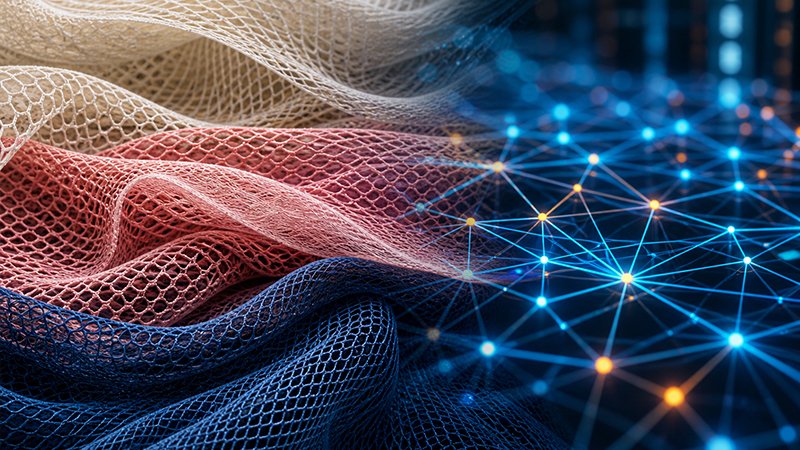
In the realm of Information Technology, the term “fabric” describes a complete structure of interconnected networking hardware. Much like a physical net, a digital fabric aims to provide a unified, scalable, and high-performance environment.
Architecture of Modern Networks
Traditional hierarchical network designs (access, distribution, and core) were often inflexible and difficult to scale. Modern AI and data-centric environments have shifted to Network Fabric architectures:
- Spine-Leaf (Clos) Architecture: This design uses layers of switches where every “leaf” switch connects to every “spine” switch, offering high bandwidth and low latency for massive data centers.
- Mesh Architecture: Similar to its textile namesake, this configuration links every device to every other device, providing maximum redundancy and failure tolerance.
- Software-Defined Networking (SDN): SDN separates the control plane from the data plane, allowing software controllers to govern network behavior dynamically.
AI-Scale Networking: NVIDIA Spectrum-X
The rise of generative AI has necessitated a new class of “lossless” net fabrics.
- Lossless Ethernet: Standard Ethernet often drops packets during congestion, which is catastrophic for AI training. Modern fabrics like NVIDIA Spectrum-X port InfiniBand innovations to Ethernet to ensure zero packet drops.
- BlueField-3 SuperNICs: These specialized components provide per-packet adaptive routing and telemetry, allowing the network to bypass congestion in real-time.
- Spectrum-X Photonics: This technology uses co-packaged optics to scale to millions of GPUs while improving power efficiency by 3.5x, effectively dismantling the “power wall” of AI factories.
Quality Control and Fabric Integrity
Whether physical or digital, a fabric is only as good as its weakest link. Rigorous inspection is required to ensure reliability.
The Role of the Fabric Checker
In the textile industry, fabric checking is the visual examination of material against specific standards. Since fabric accounts for 50-60% of total garment cost, detecting flaws early is critical.
- The Four-Point System: This is the industry standard for grading textile quality. Penalty points are assigned based on the length and severity of defects (e.g., a defect over 9 inches receives 4 points).
- Automated Visual Inspection: Advanced factories now use cameras and AI to scan fabrics. Software converts images to digital grey shades to differentiate defects from the fabric structure, saving time and increasing accuracy.
Digital Observability and Telemetry
In networking, the “inspection” process is continuous and automated.
- In-Network Telemetry: Modern fabrics use gNMI and other protocols to monitor per-flow visibility in real-time.
- Azure Operator Nexus: This cloud-native platform provides a “single pane of glass” to monitor the health, performance, and configuration changes of on-premises networking devices.
Maintenance Systems: Ensuring Longevity
To ensure the longevity and peak performance of any fabric—whether it is a physical mesh textile or a complex digital network—a structured system of maintenance is essential. Both industries rely on a combination of proactive and reactive strategies to minimize downtime and extend the lifecycle of their assets.
1. Physical Textile Maintenance Protocols
In textile manufacturing, maintenance is defined as systematic activities performed to keep factory equipment in optimum working condition and prolong its useful life. This is typically categorized into three tiers:
- Schedule/Routine Maintenance: This is planned maintenance based on specific time intervals or machine working hours, such as every 1,000 hours of operation. Consistent routine maintenance is an excellent method for keeping machines in a healthy condition, which directly improves product quality by preventing issues like irregular or broken stitches.
- Preventive Maintenance: This involves periodical and timely inspections, including cleaning, lubrication, and equipment diagnosis. By performing minor adjustments daily, manufacturers can detect and correct potential problems before they escalate into major failures that could shut down an entire production line.
- Breakdown Maintenance: This is a reactive service performed only after equipment stops functioning. While necessary for non-critical or inexpensive parts, it is unpredictable and can lead to significant “loss time” in garment manufacturing.
Furthermore, maintaining cleanliness is a core component of textile longevity. Deep cleaning using heavy-duty equipment is scheduled during slow production periods to remove accumulated dust and grunge that can affect machine productivity.
Regular cleaning ensures that the work environment remains organized, which motivates employees and prevents performance-degrading dust accumulation on sensitive equipment.
2. Digital Infrastructure Longevity
For a digital network fabric, ensuring longevity requires a shift from physical lubrication to software-driven optimization and capacity management. The goal is to ensure fast, flexible, and dependable communication throughout the life of the infrastructure.
- Firmware and Security Updates: Regular updates are critical for maintaining network integrity. Upgrading firmware and applying security fixes not only improves performance but also protects the fabric from modern security breaches.
- Monitoring and Analytics: Modern digital fabrics utilize advanced monitoring tools to track performance indicators and anticipate difficulties. For example, in-network telemetry provides real-time, granular visibility—down to nanosecond granularity—into data center networks, allowing for closed-loop optimization.
- Capacity and Disaster Recovery Planning: Longevity is also tied to scalability. Administrators must constantly monitor network usage and plan capacity improvements to meet growing demand without rebuilding the network from scratch. Additionally, creating and testing disaster recovery strategies ensures that the fabric can swiftly recover from unexpected breaches or failures.
3. The Common Thread: Standard Operating Procedures (SOPs)
Regardless of the industry, the success of a maintenance system depends on clear Standard Operating Procedures (SOPs). Documentation is vital for both textile auditors and network administrators to track the history of an asset, from installation to its most recent calibration or update.
By assigning clearly defined lines of accountability and following agreed-upon schedules, organizations can maximize their Return on Investment (ROI) and maintain the high-performance standards required by the modern AI frontier.
Conclusion: The Interconnected Future
The evolution of “net fabric” from a simple physical weave to a complex digital interconnect illustrates the universal human drive toward connectivity and resilience.
In the textile world, advancements in synthetic polymers like Nylon 6,6 and sustainable tulle variants are pushing the boundaries of what fabric can achieve in harsh environments.
Simultaneously, the digital world is adopting the mesh principles of the textile industry to build AI infrastructures capable of scaling to millions of nodes.
Whether you are an architect designing a massive AI data center or a textile engineer developing the next generation of industrial safety nets, the goal remains the same: building a resilient, flexible, and high-performance fabric that can withstand the demands of the modern era.