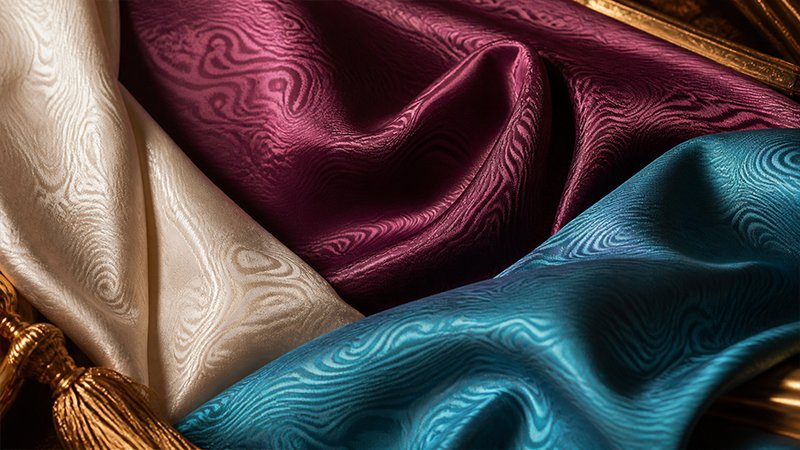
Moiré is a mesmerizing textile finish known for its hypnotic, wavy appearance that resembles rippling light on water.
Often called “watered silk,” this shimmering effect is primarily achieved through calendering, a finishing process where ribbed fabrics are subjected to intense heat and pressure.
While its origins trace back to ancient China, it became a hallmark of prestige in European royal courts during the 17th century.
Beyond its status as a luxury material for high fashion and interior design, moiré also presents a unique challenge in digital imaging as an interference artifact in photography.
This phenomenon occurs when repetitive subject patterns clash with camera sensor resolutions, illustrating the intersection of physical texture and digital science.
Decoding the “Watermark”: What is Moiré Fabric?
To understand moiré, one must first realize that it is technically a pattern or a finish, not a specific material. The name itself is derived from the French word moirer, meaning “to water,” which perfectly captures its fluid, shimmering visual quality, resembling light dancing on the surface of a lake.
The distinctive look of moiré is characterized by irregular, non-repeating wavy lines that seem to shift and vibrate as the viewer moves or as light hits the fabric from different angles. This “quiet drama” is what sets moiré apart from standard prints; it is an optical phenomenon where light and texture have a “conversation” on the surface of the cloth.
The Alchemy of Production: How Moiré is Made
The creation of “true” moiré—often referred to as moiré antique or moiré Anglaise—is a purely physical finishing process known as calendering.
The Calendering Process
Calendering involves passing fabric between heavy rollers under intense heat and pressure. To achieve the moiré effect:
- The Preparation: The fabric is typically folded lengthwise, face-side inward, with the edges (selvedges) aligned.
- The Mechanism: Ribbed rollers (sometimes filled with steam) are used to compress the cloth.
- The Transformation: The pressure crushes and flattens certain fibers while leaving others raised. Because the two layers of ribbed fabric are slightly offset as they pass through the rollers, the “ribs” of one layer interfere with the other, creating the characteristic watered pattern.
- Light Reflection: This localized crushing changes how the threads reflect light. The flattened areas reflect light differently than the round, untouched threads, resulting in a surface that appears to shimmer and “vibrate”.
Weave Variations
While calendering is the most common method, moiré effects can also be achieved through specific weaves, such as varying the tension in the warp and weft threads. Modern synthetic versions may also use engraved copper rollers to stamp the pattern onto the fabric.
The Foundation: Ideal Fabrics for Moiré
Not every fabric can be turned into moiré. The process requires a base material with a sound and compact rib structure.
- Ribbed Bases: Fabrics like grosgrain, taffeta, and faille are ideal because their pronounced horizontal ribs provide the necessary “texture” for the rollers to crush.
- Smooth Fabrics: A flat, smooth cloth like satin will not produce a moiré effect because it lacks the internal ribs required for the interference pattern to form.
- Material Composition:
- Silk: The traditional choice for luxury and the best luster.
- Synthetics: Polyester and Rayon are now common, offering durability and a similar look at a lower price point.
- Modern Innovations: Materials like Trevira (flame-resistant polyester) and recycled polyester are used today for high-traffic environments and sustainable fashion.
A Royal Heritage: 400 Years of Moiré History
Moiré’s history is a testament to its status as a “watermark of quality”.
- Ancient China: The origins date back to the Tang Dynasty (618–907 CE), where weavers first discovered that layering two fabrics with slightly different patterns created a rippling optical effect.
- European Aristocracy: By the 17th century, moiré was a symbol of absolute luxury. King William III included meters of silk moiré in his 1695 inventory for Hampton Court Palace, where it was used as wall hangings.
- The Court of Versailles: Louis XV famously covered the walls of his palaces with moiré, sparking a fashion craze among the French elite.
- Status Symbols: The fabric was often used for royal sashes (worn by Queen Victoria) and religious vestments; for instance, only Cardinals were permitted to wear a ferraiolo (cape) made of silk moiré.
- Democratization: In the 1950s, designers like Dior and Givenchy brought moiré into the mainstream, using it for “ladylike” day dresses rather than just formal ballgowns.
Moiré in Modern Interior Design: Rhythm and Quiet Drama
After falling out of favor at the end of the 20th century, moiré is experiencing a significant revival in 2025–2026 interior trends. Designers are using it to bring “rhythm” and a “balance between antiquity and modernity” to contemporary spaces.
Creative Applications
- Wallcoverings: Moiré wallcoverings (often paper-backed) add depth and texture to bedrooms and formal rooms. Philippe Desart of Arte notes that the texture changes as natural light shifts throughout the day, making it perfect for south-facing rooms.
- Hidden Details: A modern trend involves using moiré in unexpected places, such as lining the inside of a wardrobe or using it on the backs of curtains as a “little secret” revealed only from certain angles.
- Styling Pairings: Moiré sits beautifully alongside “materials with soul,” such as brass, rattan, and aged wood. For a retro look, designers pair shimmering orange moiré with chrome and Space Age decor.
High Fashion and Formal Wear
Moiré remains a staple for garments that require structure and visual impact.
- Evening and Bridal Gowns: Its ability to hold a shape makes it a favorite for full-skirted ballgowns and fitted bodices. The fabric’s “photograph-friendly” surface is highly valued for weddings and red-carpet events.
- Accessories: Moiré is frequently found in high-end handbags, footwear, jewelry boxes, and belts.
- Formal Uniforms: It continues to be used in academic regalia, religious vestments, and ceremonial uniforms where tradition is paramount.
The Photographer’s Challenge: Understanding Digital Moiré
While moiré is a desired effect in textiles, it is often an undesired “artifact” in digital photography.
What Causes Photographic Moiré?
In photography, moiré (or aliasing) occurs when the repetitive, fine pattern of a subject (like the weave of a suit or a set of window blinds) exceeds the resolution of the camera’s sensor.
The sensor’s grid of pixels cannot accurately reproduce the fine details, resulting in distorted wavy lines and strange color patterns.
How to Prevent and Fix It
- Camera Choice: Many modern cameras include an anti-aliasing (AA) filter (or optical low-pass filter) that slightly blurs the image before it hits the sensor to minimize these patterns.
- In the field, photographers can adjust their shooting angle, change the aperture (stopping down to f/8 or f/11 can help), or zoom in/out to break the interference frequency.
- Post-Production: Software like Adobe Lightroom and Photoshop offers a “Moiré reduction” slider. In Lightroom, the Adjustment Brush can be used to reduce sharpness or color noise in the affected area selectively.
Essential Care: How to Preserve Moiré Fabric
Preserving the distinctive “watered” appearance of moiré requires specialized care because the pattern is a physical finish that can be easily damaged or erased.
The Golden Rule: Avoid Water
The most critical aspect of preserving moiré is keeping it dry. Contact with water can permanently remove the watermark pattern and cause significant staining.
Because the effect is created by crushing fibers under pressure, moisture can cause those fibers to swell back to their original state, effectively “undoing” the finish.
If the fabric does get damp, you should immediately wipe it with a dry cloth and allow it to dry at room temperature, far from any direct heat sources.
Professional Cleaning and Spot Treatment
- Dry Cleaning: Professional dry cleaning is the safest and most recommended method for most moiré products, particularly those made of silk.
- Minor Stains: For small spots on synthetic moiré (such as recycled polyester), you can use a slightly dampened, delicate cotton cloth with a tiny amount of gentle detergent. However, you must be careful not to let the item become too damp.
Storage Techniques to Prevent Creasing
Moiré is prone to developing surface creases that are often impossible to steam or iron out.
- Roll, Don’t Fold: Whenever possible, you should roll the fabric rather than folding it to avoid permanent line marks.
- Padded Support: Garments should be stored on padded hangers or laid flat in tissue paper. For accessories like handbags, it is best to stuff the item to maintain its shape and store it inside a cloth dust bag.
- Weight Limits: Avoid placing heavy objects on or inside moiré items, as this can stretch and permanently deform the material.
Safe Pressing and Ironing
If ironing is necessary to remove light wrinkles, you must exercise extreme caution:
- Temperature: Use only low heat settings.
- Technique: Always press from the wrong side of the fabric and use a pressing cloth as a barrier between the iron and the material.
- Steam Caution: Since steam involves moisture, it can damage some moiré finishes; always test a small, hidden area first.
Environmental Protection
Extended exposure to direct sunlight and high heat should be avoided, as these factors can lead to irreversible deformation and color fading over time.
Types of Moiré Fabric
Moiré is primarily defined as a pattern or a finishing effect rather than a specific material. Because of this, it is categorized based on its traditional production methods, the materials used as a base, and its specific visual characteristics.
Traditional and Production-Based Types
Traditionally, moiré is divided into several categories based on how the “watered” finish is applied to the cloth:
- True Moiré (Moiré Antique and Moiré Anglaise): These are considered “true” moiré because they are created through the purely physical phenomenon of calendering. This process involves folding fabric lengthwise and passing it through ribbed rollers under high heat and pressure to crush fibers into a shimmering, irregular pattern.
- Dense Thromoir: This type is composed of high-quality silk. It is known for producing subtle optical prints with vibrant, eye-catching tones and was historically used for royal ribbons and garments.
- Moiré-Antique (Traditional Variation): Distinct from the general term, this specific type involves a process where fibers are crushed using a particular offset. It results in a volumetric decoration and a gradient matte overflow on the surface, making it popular for formal wear and elegant curtains.
Material-Based Types
The appearance and durability of moiré depend heavily on the base fabric, which must have a ribbed texture (such as grosgrain or taffeta) to hold the pattern.
- Silk Moiré Taffeta: Renowned for being the most luxurious option, it offers an exceptional drape, a soft yet structured hand, and a natural luster.
- Synthetic Moiré (Polyester, Acetate, or Rayon): These versions are more affordable and durable than silk. Modern synthetics like Trevira (a flame-resistant polyester) are often used because they require less upkeep and are more stable.
- Blended Moiré: Some types use a mix of fibers, such as the Randolph Stripe Moiré, which is a blend of cotton and linen with a subtle “watered” effect.
Visual and Style Variations
- Changeable Moiré: This term refers to fabric where the warp and weft are different colors, producing shifting effects in different lights. An example of this is shot silk.
- Moiré Taboret Stripe: This is a more sophisticated, precise version developed in the late 18th and early 19th centuries. It features intricate, controlled decorative layouts often used in high-end furnishings and historical interiors.
- Embossed Moiré: While true moiré uses ribbed rollers to interfere with the fabric’s own grain, moiré patterns can also be achieved by running fabric through engraved copper rollers to stamp the pattern onto the cloth.
Conclusion: A Timeless Aesthetic
Moiré remains a timeless symbol of sophistication, bridging the gap between historical luxury and modern innovation.
Its unique watered finish, achieved through the mechanical force of calendering, continues to captivate designers with its hypnotic ability to manipulate light and depth.
Whether adorning 17th-century royal sashes or adding “quiet drama” to contemporary 2026 interior trends, the fabric’s dual nature as a prestigious textile and a technical photographic artifact highlights its enduring relevance.
However, its shimmering beauty requires strict preservation, as even minor water exposure can permanently erase its distinctive watermark.
Ultimately, moiré’s appeal lies in its “magical shimmer,” offering a versatile aesthetic that seamlessly balances the preciousness of antiquity with the bold experimentation of the modern era.