The color blue, a hue that today permeates every facet of our lives, from the clothes we wear to the screens we interact with, boasts a history as profound and expansive as the oceans it often symbolizes.
Far from being commonplace, blue was once a rare and highly coveted pigment, its journey from ancient scarcity to modern ubiquity reflecting remarkable advancements in human ingenuity, science, and cultural expression.
This in-depth exploration will unveil the multifaceted narrative of blue, tracing its origins, its transformative impact on civilizations, its scientific revelations, and its enduring significance in art, fashion, technology, and language.
The Genesis of Blue: From Earth’s Rarity to Artistic Splendor
In its earliest forms, blue was a treasure extracted directly from the earth, primarily from minerals that yielded its precious pigments. This natural scarcity inherently elevated blue to a status of profound value, setting the stage for its deep historical roots.
Lapis Lazuli and the Birth of Ultramarine
Among the most prized natural blue pigments was lapis lazuli, a deep-blue metamorphic rock. Sourced predominantly from mines in Afghanistan, this stone was considered so precious that, when finely ground, it produced ultramarine, a pigment once valued even above gold.
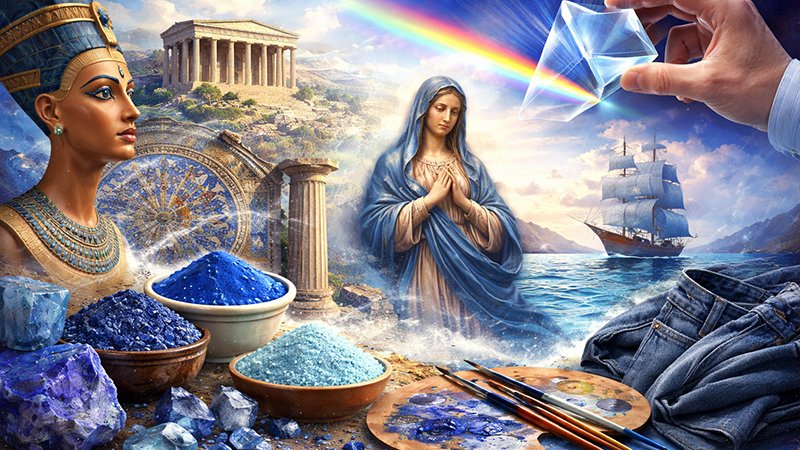
The laborious and expensive process of extracting ultramarine ensured its exclusivity. In Renaissance art, ultramarine became synonymous with divine reverence, extensively used to depict the robes of the Virgin Mary, solidifying its cultural and religious significance.
Its brilliance and rarity earned it frequent mentions in historical texts, often described as a treasure among ancient civilizations.
Azurite and the Dawn of Synthetic Creation
Another significant natural blue pigment was azurite, a copper carbonate mineral. Distinct from lapis lazuli, azurite offered a deep azure color and was more readily available, typically found in copper ore deposits, making it a popular choice for artists and craftsmen in ancient times.
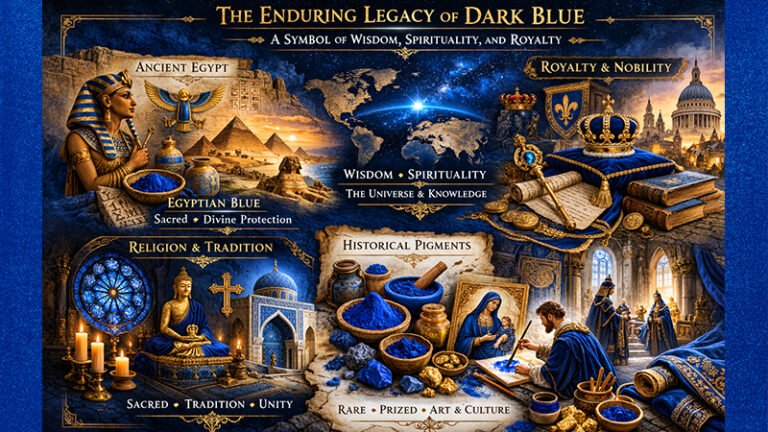
However, it was the ingenuity of the Ancient Egyptians that truly revolutionized the world of blue. They pioneered the creation of Egyptian Blue, also known as cuprorivaite, marking it as the first synthetic blue pigment in history.
Developed around 2,200 B.C., this groundbreaking pigment was meticulously crafted by heating a mixture of ground limestone, sand, and copper-containing minerals such as azurite or malachite.
Egyptian Blue was highly valued for its vivid hue and was extensively used to adorn tombs, statues, and amulets, symbolizing divinity and the universe.
Blue Through the Ages: Ancient Civilizations and Their Mastery
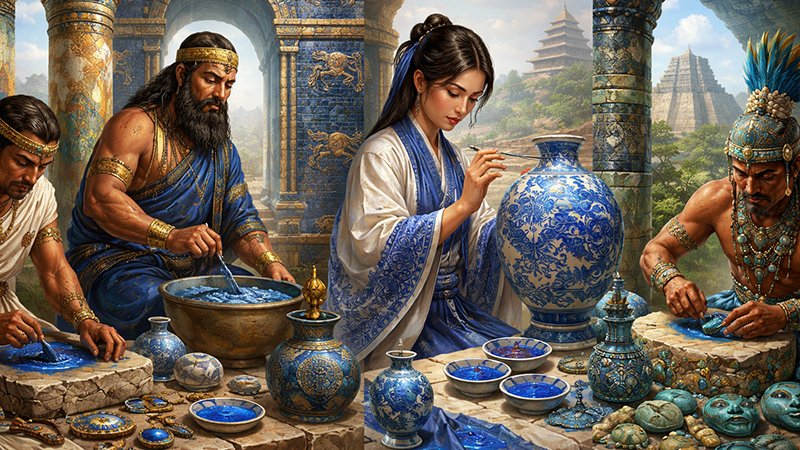
Ancient civilizations displayed remarkable prowess in both the creation and application of the color blue, demonstrating a sophisticated appreciation for its aesthetic and symbolic power.
The Groundbreaking Use of Blue in Egypt
As previously noted, the Ancient Egyptians were pioneers in developing Egyptian Blue, a synthetic pigment of unparalleled vividness.
This innovative creation was not merely decorative; it imbued their artifacts with deep symbolic meaning, representing elements of divinity and the cosmos.
The enduring presence of Egyptian Blue on archaeological finds highlights its cultural significance and marks a pivotal advancement in the technical understanding of pigment production.
Blue in the Roman Empire: A Tapestry of Trade and Artistry
The Romans, admirers of the artistic achievements of their predecessors, adopted and adapted the use of blue extensively.
They acquired blue pigments through robust trade networks, notably importing lapis lazuli for its deep blue to enrich their paintings and murals.
Beyond pigments, much of the blue dye used by the Romans originated from indigo and woad plants, primarily for dyeing textiles.
This widespread application across various social classes underscores blue’s attractiveness and versatility in Roman society.
The Romans’ integration of blue into their mosaics, frescoes, and decorative arts served not only to create visually striking works but also to convey status and sophistication, demonstrating their keen appreciation for color.
Scientific Unveilings: Deepening Our Understanding of Blue
The scientific pursuit of understanding light and color has profoundly influenced our perception and application of blue. From foundational optical discoveries to cutting-edge material science, these advancements have expanded our comprehension of this hue.
Isaac Newton and the Revelation of the Color Spectrum
A pivotal moment in the scientific understanding of color came with Isaac Newton’s seminal experiments with light.
By passing sunlight through a prism, Newton famously demonstrated that white light could be separated into a spectrum of individual colors, including blue.
This groundbreaking discovery introduced the concept of the visible spectrum, a fundamental principle in physics, establishing how different colors, characterized by their specific wavelengths, interact with human vision.
Specifically, blue light occupies a wavelength range of approximately 450 to 495 nanometers. This deeper, measurable understanding of color, rooted in physics and experimentation, has had a far-reaching impact across diverse fields, from art to technology, by providing a quantifiable basis for color classification.
Modern Color Science: Wavelengths, Energy, and Innovation
Modern science has closely studied blue light, revealing that its shorter wavelengths carry more energy.
This understanding has shaped its use in technology, especially in screens and LED lights, where blue light is essential for producing white light and enhancing displays.
Research into pigments has also advanced, with the discovery of YInMn Blue less than a decade ago—a, highly stable pigment that highlights ongoing innovation in color science.
The Cultural Tapestry of Blue: Symbolism and Emotion

Beyond its physical properties and historical applications, blue has woven itself deeply into the fabric of human culture, embodying a vast spectrum of meanings, from the sacred and noble to the deeply emotional.
Blue in Royalty and Religion: Emblems of Power and Piety
Across history, blue has symbolized both power and divinity. In medieval Europe, royal blue was reserved for kings and queens, its rarity signifying wealth and authority. Religiously, blue often represents purity and holiness.
In Christian art, the Virgin Mary is famously depicted in blue robes, underscoring her sacred role. Similarly, many world religions use blue to denote protection, spirituality, and the divine.
The Psychology and Symbolism of Blue: Calmness to Melancholy
Psychologically, blue evokes calmness, stability, and peace, inspired by its presence in the sky and sea.
Yet, it also conveys sadness and melancholy, as in the phrase “feeling blue.” This duality makes blue a versatile emotional symbol.
Artists and designers use it to balance tranquility with depth, creating moods that range from serene to introspective.
The Revolution of Synthetic Blue Pigments: Expanding Artistic Horizons
The development of synthetic blue pigments transformed art and industry by making, durable blues widely accessible.
Prussian Blue (1704)
Accidentally discovered in Berlin, it became the first modern synthetic pigment. Its deep tone and affordability replaced costly lapis lazuli, inspiring artists like Hokusai.
Cobalt Blue (1802)
Made from cobalt salts and alumina, it offered brilliance and stability, resistant to fading. Van Gogh famously used it for its striking intensity.
French Ultramarine (1828)
A synthetic substitute for natural ultramarine, created from kaolin and sulfur. Its low cost and rich color opened new possibilities for 19th-century artists.
Synthetic Indigo (late 19th century)
Chemically derived from aniline, it replaced natural indigo by 1913. Essential to the textile industry, it enabled mass production of affordable blue-dyed fabrics, especially denim.
The Technological Ascent of Blue: Powering Modern Innovation
In the modern era, blue has not only retained its cultural and artistic prominence but has also become a critical component in shaping advanced technology, particularly in areas of energy efficiency and digital displays.
Blue LEDs and the Energy Revolution
The invention of blue LEDs in the 1990s revolutionized lighting by enabling the creation of white LEDs, which are vastly more energy-efficient and longer lasting than traditional bulbs.
This breakthrough, awarded the 2014 Nobel Prize in Physics, has cut global electricity use. Additionally, the YInMn Blue pigment (discovered in 2009) offers cooling benefits when used in coatings, helping reduce building energy consumption.
Blue in Digital Displays and Advanced Technology
Blue light is essential in LCD and OLED screens, producing vivid colors and sharper images for devices from phones to TVs.
Blue lasers, with their shorter wavelength, also enhance data storage, allowing more information to fit on discs.
Blue in Fashion and Art: A Canvas of Expression
Blue’s journey has also profoundly shaped the realms of fashion and art, where it has served as both a symbol of style and a catalyst for creative innovation.
Blue Jeans and Their Global Fashion Dominance:
Blue jeans, first created by Levi Strauss in the 19th century for miners, have evolved from durable workwear into a global fashion staple.
Dyed with indigo and offered in shades from deep navy to light blue, they symbolize both comfort and style.
Their enduring popularity lies in their versatility, with the fashion industry continually innovating treatments and finishes, making blue jeans a timeless blend of tradition and modernity
Blue in Art: Connoting Mood, Depth, and Innovation
Blue has long been central to art, with pigments like ultramarine and cerulean enabling, emotive works that evoke the infinite, divine, and ethereal.
Yves Klein’s creation of International Klein Blue (IKB) highlighted its spiritual power and reshaped contemporary art.
Beyond painting, blue’s versatility extends to ceramics, textiles, and other mediums, reinforcing its historical depth and emotional impact as a favored artistic color.
Contemporary Blue: Sustainable Practices and Cutting-Edge Pigments
Modern blue production is being reshaped by sustainability and scientific innovation, offering eco-friendly solutions and expanding creative possibilities.
Bio-Indigo and Sustainability
Bio-indigo, derived from plants or produced in labs, provides a natural, chemical-free alternative to traditional indigo dyes.
This shift reduces environmental impact, supports eco-conscious fashion, and delivers consistent, high-quality color aligned with global sustainability goals.
Next-Generation Pigments
Innovations like YInMn Blue have introduced, non-toxic, and highly durable pigments, revolutionizing paints and dyes.
Advances in materials science are also producing longer-lasting, fade-resistant dyes, ensuring both artistic versatility and industrial durability.
Blue in Language and Expression: A Linguistic Evolution
Beyond its visual and material presence, the color blue has profoundly influenced linguistic evolution and cultural expression throughout human history.
The Evolution of Blue in Languages
Blue was one of the last colors to gain a distinct name in many languages. Ancient Greek and other early languages often described it using terms for green or violet.
In English, “blue” appeared around the 13th century, derived from Old French bleu. This reflects broader cultural and perceptual evolution regarding color.
Expressions and Idioms Featuring Blue: A Spectrum of Meaning
Blue appears in many expressions conveying emotion or circumstance:
- Feeling blue → sadness or melancholy
- Out of the blue → something unexpected or sudden
These idioms show how blue connects universally to human experience and emotion, enriching language across cultures.
Conclusion
The history of the color blue is a testament to its profound and multifaceted journey through human civilization.
From its origins as a rare and precious natural pigment to its widespread accessibility thanks to scientific breakthroughs, blue has continuously evolved.
Its enduring cultural, artistic, and technological significance persists today, symbolizing concepts from calmness and depth to power and divinity.
Embedded deeply in our language and omnipresent in modern technology and fashion, blue’s appeal transcends both time and disciplines.
The story of blue is a narrative of innovation, cultural meaning, and timeless allure, reflecting humanity’s endless fascination with the spectrum of colors that shape our world.