In the world of high-end design and luxury goods, few materials command the same level of respect and timelessness as leather.
Whether you are an interior designer sourcing for a corporate headquarters, a homeowner investing in an heirloom-quality sofa, or a fashion enthusiast looking for a jacket that ages with grace, understanding the nuances of leather is paramount.
However, the industry is often shrouded in confusing terminology—where “genuine” doesn’t always mean “quality” and “faux” can hide a multitude of environmental and durability concerns.
This comprehensive guide serves as your executive briefing on leather fabric. Drawing from centuries of heritage and the latest in material science, we will explore the grades, finishes, and production methods that define this elite textile.
The Heritage of Leather: A 400,000-Year Legacy
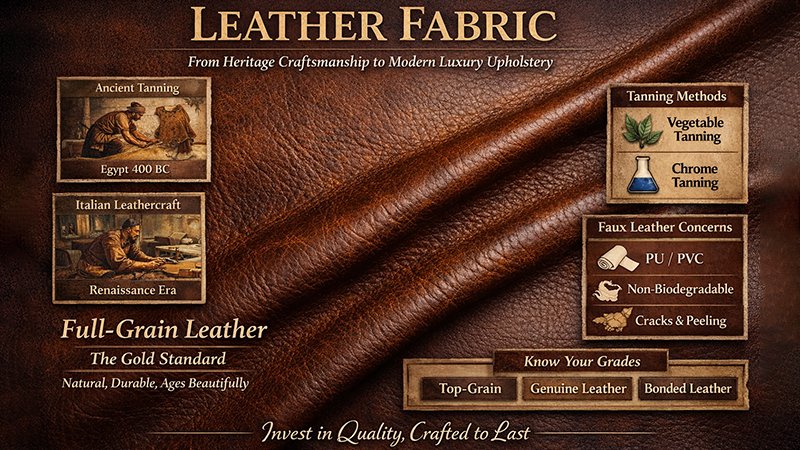
Leather is believed to be the first fabric ever crafted by human hands. While early humans used untreated skins for at least 400,000 years, the transition from raw hide to preserved textile began around 5,000 BC.
The Evolution of the Craft:
Ancient Innovation
By 400 BC, the Egyptians pioneered vegetable tanning, using plant-based tannins to prevent collagen disintegration.
Regional Mastery
Following the collapse of the Roman Empire, Arab leather workers in Morocco and Cordoba, Spain, preserved and advanced the craft.
The Italian Renaissance
By the 17th and 18th centuries, Italy established itself as the global epicenter of leathercraft, a title it still holds today.
Industrial Revolution
The late 19th century introduced mineral tanning using chromium, which significantly accelerated production times. Today, chromium tanning remains the primary method for most garments and upholstery due to its ability to create soft, stretchy hides.
Understanding the Hierarchy: Grades of Leather
When evaluating leather, the quality is determined by which part of the animal hide is used and how it is processed. Not all “genuine leather” is created equal.
Full-Grain Leather: The Gold Standard
Full-grain is the finest quality leather available. It consists of the hide with the grain (skin texture) fully intact.
- Characteristics: It features all natural scars and blemishes, meaning only the highest-quality “cleanest” hides can be used.
- Performance: It is exceptionally durable because it retains the dense, fine fibers of the outer layer.
- Aging: Full-grain leather is prized for the natural patina it develops over time, a hallmark of luxury.
Top-Grain Leather: The Professional Choice
Top-grain is the second-highest grade and the most common in luxury upholstery.
- The Process: The outermost layer is sanded or buffed (corrected) to minimize blemishes and create a uniform appearance.
- Versatility: Many top-grain leathers are split to remove the lower suede half, making the material thinner and more flexible for furniture and luxury goods.
- Protection: It often features a pigmented finish that repels liquids and resists stains, making it ideal for high-traffic environments.
Split and Genuine Leather: Proceed with Caution
Split leather is created from the lower, weaker half of the hide after the top grain is removed.
- Finished Split: Also frequently marketed as “Genuine Leather,” this is split leather that has been painted or embossed to look like a higher grade.
- Bicast / Bycast: This involves a split hide with a heavy polyurethane coating. While it looks like top grain initially, these coatings are prone to becoming tacky, peeling, or delaminating over time.
Finishes and Textures: Tailoring to Your Lifestyle
The finish of a leather determines its “hand” (feel), its visual depth, and its maintenance requirements. Fortune 500-level brands, such as American Leather, often categorize these by “Protection Levels” to assist consumers in mapping products to their specific needs.
Aniline Leather (Light Protection)
Aniline leather is the most natural-looking, typically using full-grain hides.
- The Aesthetic: The dyeing process accentuates the fiber’s natural variation, resulting in a marbled, “velvety” appearance.
- The Experience: It is warm to the touch and highly breathable but lacks a protective topcoat.
- The Risk: Its absorbency makes it highly prone to sun fading, scuffing, and staining.
Semi-Aniline Leather (Medium Protection)
A middle ground that offers the beauty of aniline with added durability.
- Construction: It features a thin, translucent finish.
- Benefit: It provides a slightly cooler, smoother feel and better stain resistance than pure aniline while still allowing the natural grain to show through.
Pigmented / Finished Leather (Heavy Protection)
The most versatile option for families, pets, and high-use commercial spaces.
- Construction: These leathers have a pigmented urethane coating that serves as a barrier.
- Benefit: They are exceptionally resistant to fading, spills, and everyday mishaps.
Special Textures: Nubuck vs. Suede
- Nubuck: This is full-grain leather that has been brushed to create a subtle, nappy texture. It is incredibly soft but very absorbent and prone to staining.
- Suede: This is the underside of the hide (or a split). It has a shaggy texture and should generally never be finished with paints or heavy coatings.
The Modern Dilemma: Faux and Bonded Alternatives
As sustainability and cost-efficiency become central to corporate social responsibility (CSR), many look toward leather alternatives. However, the performance gap remains significant.
Bonded Leather (Reconstituted)
Bonded leather is an inferior composite material made by shredding scrap leather and mixing it with adhesives.
- The Verdict: It is notorious for peeling and flaking. Because it is a composite, repairs are rarely permanent, and the material’s instability makes it a poor investment for long-term use.
Vegan and Polyurethane (PU) Faux Leather
Often marketed as a sustainable choice, most faux leathers are synthetics made from polyvinyl chloride (PVC) or polyurethane (PU).
- Durability Issues: PU coatings often develop hairline cracks and eventually peel away from their fabric backing.
- Environmental Impact: While they avoid animal hides, these synthetics are not biodegradable and their production often involves toxic chemicals.
Technical Specifications: Tanning and Production
For the professional strategist, understanding the “how” is as important as the “what.”
| Feature | Vegetable Tanning | Chrome Tanning |
|---|---|---|
| Primary Agent | Plant-based tannins (bark, seeds) | Chromium III Sulfate |
| Duration | Weeks to months | Less than one day |
| Outcome | Heavy, stiff hides (saddles, belts) | Soft, stretchy hides (upholstery, garments) |
| Eco-Impact | Low; biodegradable | High; risk of heavy metal pollution |
Global Production Hubs:
- Italy: The leader by value. Italian top-grain leather can fetch prices ten times higher than competitors due to superior artisan techniques.
- China: The leader by volume, though often associated with lower-quality, reconstituted materials.
- India and Brazil: Significant exporters, though India has faced environmental scrutiny over chromium waste management in regions like Kanpur.
Expert Care and Restoration: Preserving Your Investment
Maintaining leather is not just about cleaning; it’s about chemistry.
Cleaning
Use pH-balanced cleaners. Avoid harsh alkaline substances like saddle soap on modern chromium-tanned upholstery, as it can be too harsh.
The “Sticky” Handle Problem
High-end vehicles (like older BMW or VW models) sometimes experience “tacky” interior handles. This is often a failing decal-like coating or “slime” from heavy detailing dressings, which can be stripped with rubbing alcohol and refinished.
Color Restoration
If a high-quality top-grain leather fades, it can often be restored using specialized water-based acrylic finishes. However, changing the color of non-absorbent leathers requires aggressive cleaning with solvents like denatured alcohol to ensure the new finish adheres.
The “Scaliness” Issue
If leather begins to show “scales” or “chafing,” it is often dried out and damaged by body oils. Repair involves adding filler and plumping cushions to reduce surface stress.
Enhanced FAQ: Mapping User Intent
Q: Is “Genuine Leather” the best quality?
A: No. “Genuine leather” is often a marketing term for the lowest grade of real leather, specifically finished split hides. For the best quality, look for Full-Grain or Top-Grain.
Q: Can I repair peeling leather on my sofa?
A: If the sofa is Bonded Leather or Faux Leather, repairs are generally not recommended as they do not last. If it is real Top-Grain leather experiencing surface wear, it can be professionally refinished.
Q: What is the most durable leather for pets and children?
A: Pigmented (Finished) Top-Grain leather is the best choice. It features a heavy protection layer that serves as a barrier against spills, stains, and scratches.
Q: Why does my leather feel cold?
A: Finished or pigmented leathers tend to feel cooler because of their protective urethane coating. In contrast, unfinished aniline leather feels warmer and more “velvety” because it is more breathable.
Q: Is vegan leather more environmentally friendly?
A: Not necessarily. Most vegan leathers are plastic-based (PVC/PU), which are not biodegradable and release toxins during production. Vegetable-tanned genuine leather is often considered the most sustainable traditional option.
Strategic Conclusion: Choosing Excellence
In the modern market, leather remains a symbol of Expertise, Authoritativeness, and Trustworthiness (E-A-T). For Fortune 500 companies and discerning consumers, the choice of leather is a statement of longevity over disposability.
When sourcing leather:
- Prioritize Origin: Italian-tanned hides remain the global benchmark for quality and artisan craft.
- Match Protection to Use: Don’t put “Light Protection” aniline in a high-traffic lobby.
- Beware of “Genuine” Labeling: Verify if the material is full-grain, top-grain, or a split hide.
By understanding the technical properties and the rich history of leather fabric, you ensure that your investments—whether in fashion or furniture—stand the test of time, developing a patina that tells a story of quality.