In the fast-evolving landscape of the global textile industry, few fabrics manage to bridge the gap between historical luxury and modern mass-market appeal as seamlessly as lawn cloth.
Originally a product of European artisanal mastery, lawn has transformed into a multi-billion dollar cultural phenomenon, particularly within South Asian markets, while remaining a staple for Western high-fashion designers.
This comprehensive report explores the technical specifications, historical evolution, and socio-economic impact of lawn cloth, providing essential insights for designers, manufacturers, and textile enthusiasts.
Defining Lawn Cloth: The Technical Foundation
At its core, lawn cloth is a high-quality, plain-weave textile traditionally celebrated for its silky texture and sheer appearance. While it was historically crafted from linen, modern iterations are almost exclusively composed of high-grade cotton.
The Anatomy of the Weave
The distinctive “hand” or feel of lawn cloth is a result of its specific construction parameters:
Weave Structure
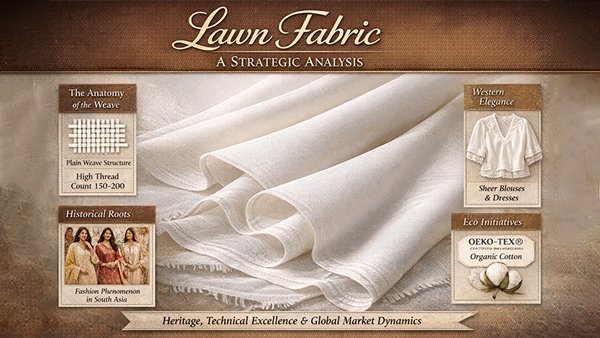
It utilizes a standard plain-weave method, where weft threads alternate over and under warp threads in a simple grid. This makes the fabric exceptionally stable and easy to manipulate during the cutting and sewing process.
Thread Count & Density
A hallmark of premium lawn is its high thread count, typically ranging between 150 and 200. More specifically, technical specifications often reveal a warp count of approximately 70 and a weft count of 100, with a density of 80 ends per inch (EPI) and 80 picks per inch.
The “Crisp” Factor
Unlike softer drapes like voile, lawn is known for being crisp to the touch. This inherent crispness is often a result of the high-quality yarn used, though some manufacturers apply a starched finish to achieve a similar effect in lower-grade variations.
A Heritage of Refinement: From Laon to the World
The narrative of lawn cloth is one of geographical and material transition. The fabric derives its name from the French city of Laon, where it was first pioneered by local weavers.
The Material Shift
Initially, lawn was a linen-based product, reflecting the abundance of flax in Europe. However, as the 17th century ushered in the era of global trade, the influx of Indian cotton fundamentally altered the European textile landscape.
Weavers discovered that cotton provided a comparable level of fineness with increased versatility, leading to the cotton-dominated lawn we recognize today.
The Birth of “Persian Lawn”
By the 19th and early 20th centuries, lawn cloth had become a symbol of colonial elegance and academic tradition.
It was famously used for women’s commencement gowns and was often referred to as “Persian lawn,” a moniker that highlighted its immense popularity across South Asia and the Middle East. This period established lawn as a “global” fabric, moving beyond its French origins to become a preferred material for high-heat climates.
The Socio-Economic Phenomenon: “Lawn Fever”
While Western markets view lawn as a versatile dressmaking fabric, in Pakistan and India, it is a cultural and economic powerhouse. The fabric’s breathability and moisture-wicking properties make it the ideal substrate for the salwar kameez, or “lawn suit”.
The Rise of the Designer Lawn Suit
In Pakistan, the production of finished lawn garments has reached an industrial scale that dwarfs almost any other region. This has given rise to “Lawn Fever,” an annual spring event where consumers compete to purchase the latest trending patterns.
- Cultural Significance: Intricate, printed designs have become an integral part of the annual style culture.
- Economic Impact: Designer lawn suits are not merely clothing; they are status symbols. High-end seasonal styles can command “absurd sums of money,” reflecting the fabric’s transition from a utility textile to a luxury commodity.
Strategic Applications in Modern Garment Design
The utility of lawn cloth varies significantly between Eastern and Western fashion houses, showcasing the fabric’s remarkable adaptability.
Western Design Applications
In Europe and North America, lawn is prized for its lightweight nature, making it a primary choice for:
- Apparel: Sheer blouses, summer shirts, skirts, and dresses.
- Intimate Wear: Due to its exceptional softness, it is frequently used for lingerie and undergarments.
- Specialty Items: Historically the most sought-after textile for handkerchiefs, lawn is currently finding a niche in pinafores—lightweight garments for children.
Global Manufacturing Preferences
A key differentiator in production is the treatment of the fabric surface. While South Asian markets almost exclusively utilize printed lawn, Western designers often prefer dyed or bleached-white variations.
Comparative Analysis: Navigating Lawn and its “Cousins”
To the untrained eye, many lightweight cottons appear identical. However, for the Fortune 500-level designer, understanding the subtle nuances between lawn and its relatives is critical for product positioning and quality control.
| Fabric Type | Key Differences from Lawn | Primary Use |
|---|---|---|
| Nainsook | A subtype of lawn made exclusively with combed yarn; ultra-soft. | Luxury undergarments |
| Batiste | Finer and more sheer than standard lawn. | Ecclesiastical garments |
| Voile | Thinner and softer; reminiscent of silk. | Sheer drapery/dresses |
| Organdy | Significantly crisper and more transparent than lawn. | Formal wear accents |
| Cambric | Historically similar to batiste; a primary competitor to linen. | Shirting/Linings |
The Global Supply Chain: Production and Logistics
Understanding where lawn cloth is sourced is essential for maintaining supply chain transparency and cost-efficiency.
Raw Material Leaders
India currently stands as the world’s largest producer of cotton fiber, while the United States has recently regained its status as a major exporter following economic shifts in China.
The Manufacturing Hub
China remains the largest global producer of finished textile products overall. However, for specific lawn-suit production, the expertise lies within Pakistan and India.
Cost Drivers
Lawn is generally inexpensive, but price points are dictated by the yarn quality. Combed yarn is softer and more expensive to produce than carded yarn, which has a rougher texture.
Sustainability and Environmental Stewardship
As the global fashion industry moves toward a more ethical future, the environmental impact of lawn cloth (cotton) is under intense scrutiny.
The Environmental Challenge
Cotton cultivation can be resource-intensive. In many regions, it is produced as a monocrop, which can lead to:
- Soil degradation.
- Heavy reliance on chemical pesticides and fertilizers.
- Release of toxins into local biospheres.
- Social Impact: In some developing nations, the industry has been linked to exploitative labor practices.
Pathways to Sustainability
To mitigate these risks, industry leaders are turning to certified sustainable processes.
- OEKO-TEX: A critical certification for ensuring the absence of harmful substances in the finished textile.
- Organic Certification: Government-led certifications in the US and EU verify that the cotton was grown without toxic synthetic inputs.
- Supima (ASA): For high-end lawn made with Pima cotton, certification by the American Supima Association ensures a superior, long-staple fiber quality.
Enhanced FAQ: Expert Insights for Professionals
Q: Why should I choose lawn over voile for a summer collection?
A: Lawn provides a unique balance of breathability and structure. While voile is softer and more “drapey,” lawn’s crisp hand allows it to hold tailored shapes better, making it superior for structured blouses or pleated skirts.
Q: Is lawn cloth prone to pilling or bubbling?
A: No. Due to its high thread count and plain-weave construction, lawn has a low tendency to pill or bubble, ensuring a longer lifespan for the garment compared to lower-quality knits.
Q: What is the recommended needle size for sewing lawn?
A: Given the fabric’s fine nature and high thread count, it is imperative to use a fine needle to avoid snagging or creating visible holes in the weave.
Q: How does “combing” improve the fabric quality?
A: The combing process removes shorter fibers and impurities, resulting in a stronger, smoother, and softer yarn. This is why combed lawn (Nainsook) commands a higher market price.
Conclusion: The Strategic Value of Lawn
Lawn cloth represents a unique intersection of history, comfort, and commercial opportunity. From its origins in Laon to the frenzied “Lawn Fever” of Pakistan, it remains a testament to the enduring appeal of high-quality cotton craftsmanship.
For brands seeking to dominate the summer market, lawn offers a reliable, breathable, and culturally resonant substrate that meets the rigorous demands of the modern consumer.