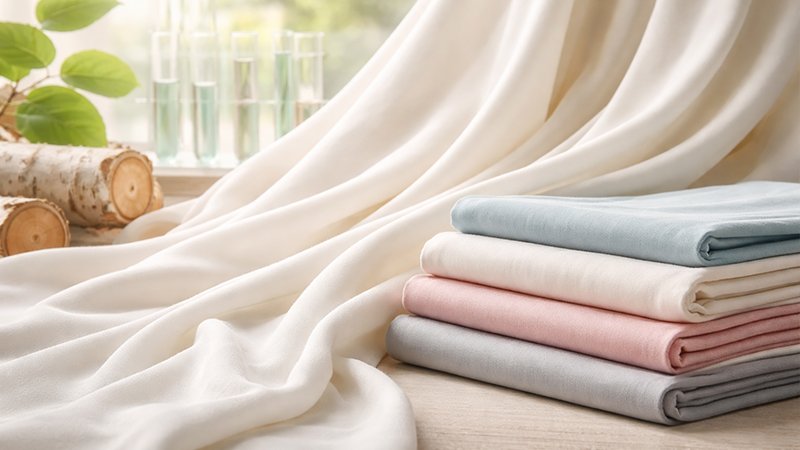
In the rapidly evolving landscape of high-performance textiles, modal fabric—scientifically known as High-wet-modulus (HWM) rayon—has emerged as a premier choice for both luxury and utility.
First developed in Japan in 1951, this semi-synthetic material represents a sophisticated evolution of traditional viscose, engineered to offer a superior hand-feel with significantly less industrial waste.
By blending cellulose from hardwood trees like birch and oak with advanced synthetic processes, modal delivers exceptional breathability, moisture-wicking properties, and a resistance to pilling that surpasses cotton.
From high-end activewear to luxury bedding with thread counts reaching 300, modal is redefining modern comfort. This guide analyzes modal’s industrial lifecycle, market positioning, and critical sustainability factors.
The Genesis of High-Wet-Modulus (HWM) Rayon
Modal fabric, scientifically classified as High-wet-modulus (HWM) rayon, represents a pivotal chapter in the history of manufactured fibers.
While often marketed alongside natural fibers due to its botanical origins, modal is a semi-synthetic textile that bridges the gap between the organic world and advanced chemical engineering.
A Historical Trajectory of Innovation
The journey of modal began in 1951 in Japan, emerging as a direct response to the limitations of early viscose rayon. To understand modal, one must understand its predecessor.
Early forms of rayon developed in the late 19th century were notoriously expensive and flammable. While the 20th-century development of viscose solved safety and cost issues, the process remained inefficient and environmentally taxing.
Modal was engineered as an evolution—a “structurally superior” update to viscose that simplified the manufacturing steps and significantly reduced the resulting waste.
Today, while Japan remains a niche producer, the epicenter of modal production has shifted to China, alongside significant outputs from India, Pakistan, and Europe.
Molecular Excellence: The Properties of Modal
For a textile it must offer measurable performance advantages. Modal excels through a unique combination of high-tech durability and silk-like aesthetics.
1. Breathability and Moisture Management
Modal is engineered for high performance. It boasts superior breathability and high moisture-wicking abilities, making it a primary choice for high-intensity sportswear.
Unlike fabrics that trap heat, modal maintains a low heat retention profile, ensuring comfort in active or thermal environments.
2. Structural Integrity and Texture
One of the most significant pain points in cotton-based textiles is “pilling”—the formation of small fiber knots that disfigure the fabric.
Modal is highly resistant to pilling, ensuring that garments maintain their “brand new” look and feel after multiple washes. Furthermore, modal offers:
- High Stretchability: Providing the “give” necessary for modern athletic and leisurewear.
- Silky Tactility: Originally developed as an alternative to silk (once known as “artificial silk”), modal provides a luxurious hand-feel without the prohibitive cost or fragility of traditional silk.
- Premium Thread Counts: In the bedding sector, modal can achieve thread counts between 150 and 300, qualifying it as a luxury material for domestic textiles.
The Industrial Lifecycle: How Modal is Made
The transformation from hardwood to high-fashion is a complex chemical and mechanical process.
Step 1: Harvesting and Cellulose Extraction
The process begins in the forest. Modal is primarily derived from the cellulose of hardwood trees, specifically birch and oak.
These trees are harvested and rendered into small chips, approximately the size of a postage stamp. These chips are then purified to extract the raw cellulose, while non-cellulose tree materials are discarded.
Step 2: The Steeping and Xanthation Phase
The extracted cellulose is formed into sheets and immersed (steeped) in sodium hydroxide (caustic soda). A key differentiator for modal is that it uses significantly lower concentrations of sodium hydroxide than viscose rayon, resulting in less toxic waste.
Once steeped, the sheets are broken into “crumbs.” Unlike viscose, these crumbs do not undergo an aging process; instead, they are immediately treated with carbon disulfide.
This chemical reaction transforms the crumbs into sodium cellulose xanthate, a vibrant orange substance. At this precise molecular stage, the material transitions from “organic” to “semi-synthetic”.
Step 3: Spinning and Finishing
The xanthate is dissolved in caustic soda again to create a syrupy solution, which is instantly forced through a spinneret to form fine fibers. These fibers are then:
- Immersed in sulfuric acid to solidify.
- Stretched and formed into yarn.
- Washed, bleached, and dried.
- Subjected to post-treatments such as pre-shrinking, wrinkle resistance, or flame retardancy.
Market Applications: From Yoga Mats to Luxury Linens
The versatility of modal has made it a staple for global brands. Its unique property set allows it to penetrate diverse market segments.
- Activewear and Sportswear: Due to its durability and wicking profile, modal is a dominant material in yoga pants, bike shorts, and swimwear. It is easy to clean and maintains its shape under physical stress.
- Intimate Apparel: The softness and thinness of modal make it the gold standard for underwear and T-shirts.
- Luxury Bedding: Because it is kept close to the skin for prolonged periods, modal’s silky texture makes it a preferred choice for high-end bed sheets.
- Textile Blends: It is increasingly common to see modal blended with silk or cotton to enhance the durability of scarves and nightwear while maintaining a premium feel.
The Sustainability Paradox: Environmental and Ethical Impact
While modal is often marketed as “eco-friendly,” the reality is nuanced.
The Chemical Challenge
The modal manufacturing process involves carbon disulfide, a known neurotoxin. Exposure to this chemical during production can lead to severe medical issues for factory workers, including liver and kidney damage, psychosis, and even death. Furthermore, if not properly managed, contaminated water and air emissions can devastate local ecosystems.
The Sustainable Path Forward
Modern industry leaders are taking steps to mitigate these risks. Advanced factories utilize chemical scrubbers and absorption machines to trap carbon disulfide before it reaches workers or the environment.
The primary producer, Lenzing AG, serves as a benchmark for the industry. Based in Europe but operating globally, Lenzing ensures its cellulose is from sustainably harvested forests certified by the PEFC.
Because modal is semi-synthetic, it cannot be certified as “organic,” but PEFC certification provides a critical trust signal for environmentally conscious consumers.
Comparative Matrix: Modal vs. The Competition
To assist in decision-making, we must evaluate modal against its primary textile rivals.
| Feature | Modal | Viscose Rayon | Lyocell | Cotton |
|---|---|---|---|---|
| Origin | Semi-synthetic | Semi-synthetic | Purely organic | Natural |
| Durability | High | Low | High | Medium |
| Pilling | Low resistance | High pilling | Low pilling | High pilling |
| Eco-Impact | Moderate | High | Low (Closed-loop) | Variable |
| Production | 8-step process | Complicated/Wasteful | Simplified/Organic | Agricultural |
| Cost | Mid-range | Low | Mid-high | Mid-range |
Enhanced FAQ: Navigating Consumer Intent
Q: Is modal fabric better than cotton?
A: “Better” depends on use. Modal is more breathable, more moisture-wicking, and significantly more resistant to pilling and shrinking than cotton. However, cotton is a fully natural fiber, whereas modal involves chemical processing.
Q: How should I wash modal garments?
A: To maintain the integrity of the fibers, it is recommended to wash modal in cold water.
Q: Is modal fabric biodegradable?
A: While derived from wood cellulose, the chemical alterations (xanthation) mean it does not behave exactly like a natural fiber. However, it is generally more sustainable than purely synthetic fabrics like polyester.
Q: Why is modal called “artificial silk”?
A: This was a historical marketing term for early rayons due to their shimmering texture and softness. Modern modal is much safer (non-flammable) than those early versions.
Strategic Conclusion: The Future of Fiber
Modal fabric is a testament to human ingenuity—a material that takes the best of nature (cellulose) and refines it through science to meet the demands of a high-performance world.
For the consumer, it offers unparalleled comfort and longevity. For the manufacturer, it offers a more efficient, less wasteful alternative to traditional viscose.
As we move toward a more transparent global supply chain, the “Modal standard” will be defined by those who prioritize PEFC-certified sourcing and worker safety.
By choosing modal, you are participating in a textile evolution that values both the feel of the fabric and the future of the planet.