
In the modern landscape of high-performance textiles and sustainable luxury, few materials command as much respect and historical weight as linen.
Often synonymous with effortless elegance and architectural durability, linen is far more than a simple summer fabric.
It is a high-performance bast fiber derived from the flax plant (Linum usitatissimum), a resilient crop that has clothed kings, protected warriors, and served as a global currency for millennia.
For the discerning consumer and professional alike, understanding linen is an exercise in appreciating the intersection of nature’s engineering and human craft.
This guide provides a comprehensive analysis of linen’s properties, its 36,000-year history, the rigorous manufacturing processes that define its value, and the essential care required to maintain its status as a multi-decade investment.
Defining the Architecture of Linen: The Bast Fiber Advantage
To understand linen is to understand its biological origin. Unlike cotton, which grows in soft bolls around the seeds of the plant, linen is a bast fiber. This means the fibers are extracted from the inner bark (the phloem or “bast”) of the flax plant’s stalk.
The Cellular Superiority of Flax
Flax fibers are naturally long—typically ranging from 25 to 150 mm—making them significantly longer than cotton staples.
Under a microscope, these fibers reveal distinctive “nodes” and irregular polygonal shapes that contribute to the fabric’s signature textured feel and structural flexibility.
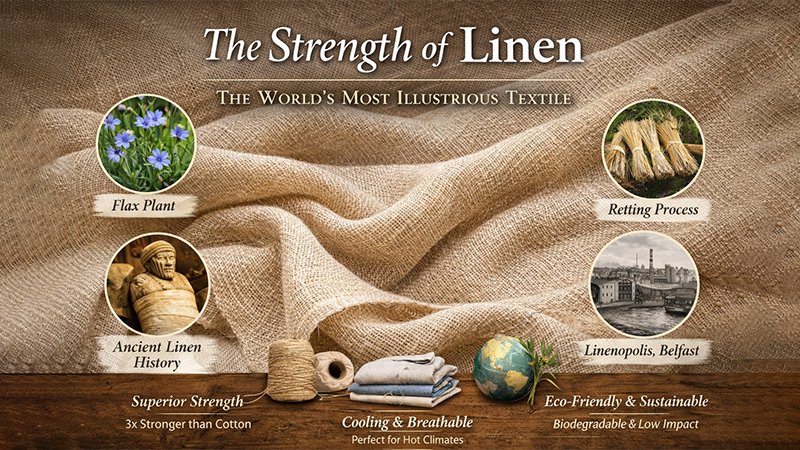
Because these cellulose fibers are wrapped tighter and are longer than those in cotton, linen possesses a tensile strength that is up to three times greater than cotton.
Remarkably, linen is one of the few textiles that actually increases in strength when wet, with its tensility rising by approximately 20%.
This property historically made it the preferred material for high-stress applications like sail-cloth, ropes, and even ancient body armor known as linothorax.
The Etymological Heritage: Decoding “Linen” vs. “Linens”
In the realm of global commerce and interior design, terminology is often used loosely, but for professional standards, precision is paramount. There is a critical distinction between the fabric and the category.
- Linen (The Fabric): Refers specifically to textiles made from the flax plant.
- Linens (The Category): An anachronistic, collective term used to describe household goods like bed sheets, towels, and tablecloths, which today may be made of cotton or synthetics.
The word linen is of West Germanic origin and is cognate to the Latin name for the flax plant, linum.
This word history has given rise to several ubiquitous English terms: “line” originates from the use of a linen thread to determine a straight line; “lining” refers to the linen inner layers traditionally used in fine garments; and “lingerie” is a direct cognate that originally denoted linen underwear.
A 36,000-Year Legacy: From the Caucasus to “Linenopolis”
Linen is arguably the world’s oldest domesticated textile, with a history that tracks the very dawn of human civilization.
Prehistoric Origins and Antiquity
The earliest evidence of linen use dates back to 30,000 to 36,000 years ago, found as dyed wild flax fibers in a cave in the Republic of Georgia.
By 8,000 BC, flax fragments appeared in Swiss lake dwellings, and by 7,000 BC, woven fragments were utilized in burial rites at Çatalhöyük.
In Ancient Egypt, linen was the cornerstone of society. Worn for its ability to reflect the sun and provide rapid cooling, white linen was a symbol of light and purity.
It was used as currency, for burial shrouds, and by the priesthood of Isis. The Tarkhan dress, one of the world’s oldest woven garments (circa 3482–3102 BC), stands as a testament to the fabric’s incredible archival integrity.
The Industrial Peak: Linenopolis
While the Phoenicians introduced linen to Western Europe, it was Ireland that eventually became the global epicenter of production.
Following the revocation of the Edict of Nantes in 1685, Huguenot refugees brought advanced weaving techniques to the British Isles.
The city of Belfast rose to such prominence during the Victorian era that it was dubbed “Linenopolis,” producing the majority of the world’s supply.
The Science of Comfort: Why Linen Dominates Search Intent
Consumer interest in linen is driven by its unparalleled performance in high-temperature environments. It is the gold standard for moisture-wicking and thermal regulation.
The Cooling Mechanism
Linen has high thermal conductivity, which makes it feel cool to the touch—a principle similar to how metal feels colder than wood at the same temperature.
Its loose weave allows for superior ventilation, while the fiber itself can absorb up to 20% of its weight in moisture before feeling damp.
Because it dries faster than cotton, it rapidly dissipates perspiration, preventing the “clingy” sensation common with other natural or synthetic fabrics.
The Slub Aesthetic
Authentic linen is characterized by “slubs”—small, soft, irregular lumps along the yarn.
While historically viewed as defects, modern luxury markets embrace slubs as a hallmark of a natural, high-end product. However, the very finest professional-grade linens feature threads of a highly consistent diameter with no slubs at all.
The Labor of Luxury: How Linen is Crafted
The high cost of linen—with woven fabrics fluctuating between $5 and $12 per yard—is a direct result of its laborious and time-intensive manufacturing process.
- Planting and Harvesting: Flax thrives in cool, humid areas and is ready for harvest after about 100 days. To preserve the longest possible fiber length, flax is often hand-pulled up by the roots or cut extremely close to the ground.
- Rippling: The seeds and leaves are removed from the dried stalks through a mechanized process.
- Retting: This is the most critical stage. Moisture and bacteria (or chemicals) are used to decompose the pectin that binds the fibers to the woody stalk.
- Water retting (in tanks or fields) is the traditional method preferred for organic certification.
- Chemical retting is faster but can be damaging to the environment and the fibers.
- Breaking and Scutching: The stalks are crushed between metal rollers to separate the usable inner fibers from the woody outer portions.
- Heckling: The fibers are combed to separate short “tow” fibers (used for coarser fabrics) from long “line” fibers (used for fine textiles).
- Spinning: Because flax is inelastic, it is typically spun in wet, humid conditions to ensure the yarn remains cohesive.
The Four Pillars of Linen Variety
Depending on the weave and intended use, the fabric is categorized into four primary types:
| Type | Characteristics | Primary Uses |
| Damask Linen | Ornate, delicate, woven on a Jacquard loom. | Decorative items, formal tablecloths. |
| Plain-Woven | Durable, relatively loose weave. | Dish towels, hand towels. |
| Loosely-Woven | Highly absorbent but least durable. | Reusable diapers, sanitary napkins. |
| Sheeting Linen | High thread count, untextured, soft surface. | Apparel, luxury bed sheets. |
Sustainability and Global Impact: The Ethical Choice
In an era defined by environmental goals, linen stands out as one of the most sustainable textiles available.
- Resource Efficiency: Flax requires significantly less water and fewer pesticides than cotton to reach maturity.
- Biodegradability: As a natural plant fiber, linen is fully biodegradable, often degrading in just a few weeks when buried in soil.
- Soil Health: Flax is frequently used in crop rotation to maintain soil health and can grow in poor soil conditions.
- Global Producers: China is currently the top exporter of woven linen. However, high-quality heritage production remains vital in Italy, Belgium, and Ireland.
Diverse Modern Applications: From Apparel to Currency
While 70% of linen production was used for clothing by the 1990s, its utility extends far beyond the runway:
- Apparel: Suits, dresses, and shirts valued for their natural drape and cooling properties.
- Home Decor: Wallpaper, upholstery, curtains, and high-end bedding.
- Art and Industry: Linen is the preferred archival support for oil painting. In the industrial sector, it is used for luggage, sewing thread, and even U.S. currency, which is composed of 25% linen.
- Culinary: Artisan bakers use a linen “couche” to hold dough in shape during its final rise because it provides a natural non-stick surface.
Essential Care Guide: Making Your Investment Last
Linen is an incredibly resilient fabric that can last for decades, becoming softer and more lustrous with every wash. However, its poor elasticity means it requires specific care to prevent thread breakage.
Washing and Drying
- Temperature: Use a gentle cycle with cold or lukewarm water.
- Detergent: Avoid harsh chemicals or bleach that can break down fibers.
- Drying: Air drying is recommended to preserve texture and prevent shrinkage. If using a dryer, remove the fabric while still damp to minimize wrinkles.
Ironing and Storage
- The “Damp” Rule: Linen is much easier to iron when damp.
- Avoid Sharp Folds: Constant creasing in the same spot can eventually break the threads.
- Storage: Store in a cool, dry place. Fold neatly rather than creating tight creases to prevent yellowing or damage.
Enhanced FAQ: Expert Insights
1. Does linen shrink when washed?
Yes. Natural linen can shrink by 3% to 4% during its first wash due to fibers contracting. Washing in cold water and air drying is the best way to mitigate this.
2. Why is linen considered hypoallergenic?
Linen is naturally hypoallergenic and lint-free, making it an ideal choice for individuals with sensitive skin or allergies.
3. Is linen better than cotton for hot weather?
While cotton is initially softer, linen is more breathable and dries faster. Its ability to wick moisture and allow airflow makes it superior for equatorial climates.
4. What are “slubs”?
Slubs are small, irregular lumps in the yarn. Once considered defects, they are now often seen as part of the aesthetic appeal of an expensive natural product, though the finest linens lack them entirely.
Conclusion: The Ultimate Investment in Quality
From the burial chambers of Ancient Egypt to the modern artisan bakery, linen has remained a constant symbol of resilience and refined taste.
Its unique combination of extreme durability, rapid absorbency, and environmental sustainability makes it an unmatched material for both apparel and home furnishings.
While it requires a higher initial investment and specialized care compared to cotton, the longevity of linen ensures it is a choice that pays dividends for decades.
Embrace the natural wrinkles, appreciate the 36,000-year history, and invest in the enduring strength of flax.


