In an era of fast fashion and industrial homogenization, few textiles carry the weight of history, the soul of a nation, and a blueprint for a sustainable future quite like Khadi.
Often referred to as the “Fabric of India,” Khadi is far more than a textile; it is a movement, a legacy, and a testament to the power of human craftsmanship.
This comprehensive guide delves into the intricate world of Khadi—from its origins in the Indian freedom struggle to its technical nuances and its role as a modern icon of ethical luxury.
1. Defining Khadi: More Than Just Cotton
To the uninitiated, Khadi (pronounced [kʰaːdiː]) may look like any other natural fabric. However, its definition lies in its rigorous production method.
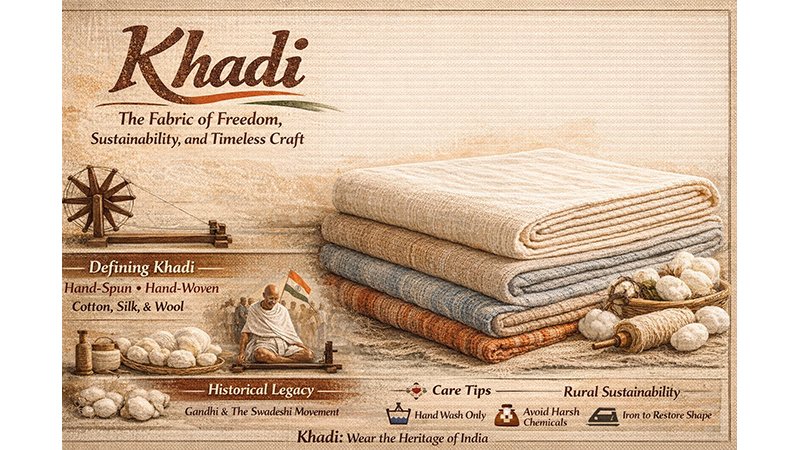
Derived from the word khaddar, Khadi is a natural fiber cloth that is uniquely hand-spun on a spinning wheel (charkha) and hand-woven on a loom.
While cotton is the primary fiber used, Khadi is a versatile category that includes silk and wool. The defining characteristic is the manual intervention at every stage of the yarn’s creation.
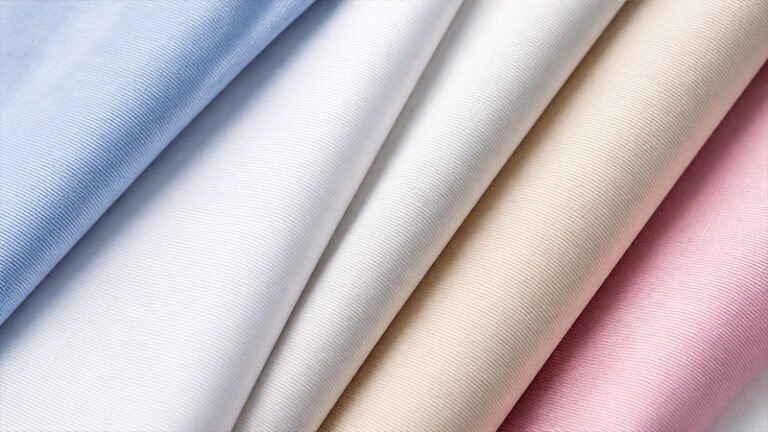
Unlike mill-made fabrics where machines dictate uniformity, Khadi thrives on the subtle irregularities of human touch, giving it a “rustic charm” and a unique texture that no machine can replicate.
2. The Historical Soul: From Sabarmati to a National Symbol
The story of Khadi is inextricably linked to Mahatma Gandhi and the Indian independence movement. To understand its value today, one must look back at its role as a “silent economic revolution”.
The Swadeshi Movement
During the British colonial era, the Indian textile industry faced a crisis. The British government exported raw cotton to mills in Manchester and Lancashire, only to re-import the finished cloth to India at inflated prices.
In 1917–18, at the Sabarmati Ashram, Gandhi promoted the first piece of hand-woven Khadi as a tool for economic self-reliance (Swadeshi).
A Tool for Resistance
Gandhi envisioned Khadi as a way for villagers to achieve self-employment. He made it obligatory for members of the Indian National Congress to spin their own yarn.
This was not merely about clothing; it was about breaking the monopoly of foreign mills and empowering the grassroots of India.
Gandhi himself took to wearing only a dhoti made of Khadi, demonstrating his commitment to the fabric even when others complained of its coarseness or cost.
3. The Art of the Spin: The Technical Craftsmanship
The production of Khadi is a masterclass in traditional mechanics. It relies on the charkha, a tool that has evolved from basic floor models to the more portable Patti Charkha invented by Gandhi to increase speed and control.
The Mechanics of the Twist
The technical integrity of Khadi yarn is determined by the “twist.” In manual spinning:
- Single plies are typically spun with a Z-twist.
- Plying (combining threads) is done with an S-twist. This opposite-direction plying is crucial—it prevents the hand-spun yarn from untwisting itself, ensuring the fabric’s durability.
The Weaving Process
Once the yarn is spun, it is moved to a handloom. The hand-weaving process allows more air to permeate the threads compared to power looms, resulting in a fabric that is highly breathable and soothing to the skin.
This manual process makes Khadi versatile for all seasons: it remains cool in the sweltering heat of summer and provides surprising warmth in the winter.
4. Understanding Thread Counts and Varieties
Khadi is not a monolithic fabric. Its variety ranges from heavy-duty utility cloth to gossamer-thin luxury textiles.
- 20-Count Khadi: A thicker, more rugged variety ideal for upholstery and heavy outerwear.
- 60-80 Count Khadi: A standard weight suitable for structured shirts and day dresses.
- 100-120 Count Khadi: Fine, lightweight varieties perfect for summer tunics.
- Muslin Khadi (500-1000 Count): This is the pinnacle of the craft. Producing such fine yarn requires highly skilled weavers and specific environmental conditions to prevent the delicate threads from snapping. Muslin Khadi is particularly famous in Bangladesh, where it received Geographical Indication (GI) status in 2020.
Khadi Silk and Blends
Beyond cotton, the Khadi movement encompasses exquisite silk varieties. Pure Khadi silk is woven entirely from hand-spun silk yarn. Other popular blends include:
- Matka Khadi Silk
- Tussar Khadi Silk
- Ketya Khadi Silk.
5. The Sustainability Powerhouse: Why Khadi Wins in the 21st Century
In the modern context of climate change and environmental degradation, Khadi emerges as one of the most eco-friendly textiles in existence.
Energy Efficiency
Data shows that Khadi is approximately 3.24 times more energy-efficient than mill-produced cloth. Because it relies on human power rather than electricity for spinning and weaving, its carbon footprint is negligible.
Ethical Production
Choosing Khadi directly supports rural artisan clusters. In India alone, there are over 2,600 functional Khadi institutions.
Health and Comfort
Khadi is a body-friendly fabric. It is non-allergenic and does not cause the irritations often associated with synthetic, chemically-treated fabrics.
6. Protecting the Legacy: Trademarks and Modern Challenges
As Khadi has gained international prestige, protecting its identity has become a legal priority. The Khadi and Village Industries Commission (KVIC) holds exclusive rights to the trademarks “Khadi” and “Khadi India”.
India has successfully fought legal battles in the EU, Mexico, and the UAE to ensure that “Khadi” is not used as a generic term by private entities.
This protection is vital because true Khadi represents a specific standard of hand-spun, hand-woven quality that generic “handloom” or mill-made cotton cannot claim.
Despite this, the industry faces challenges. The number of traditional weavers is declining due to fluctuating demand and the inherent difficulties of working with irregular hand-spun yarn, which can lead to inconsistent dyeing.
Organizations like Anuprerna are now working to bridge this gap by connecting rural weavers with global markets.
7. Care Guide: Preserving Your Khadi
To maintain the “fresh, refined look” of Khadi, proper care is essential.
- Hand Washing: Always opt for hand washing over machine cycles.
- Avoid Harsh Chemicals: Do not use strong chemical detergents, as they can weaken the natural fibers.
- Ironing is Key: Khadi is prone to shrinking, but it can be easily restored to its original shape and crispness through ironing.
- Starching: For those who prefer a stiffer, more formal feel, Khadi can be starched to improve its appearance.
8. Enhanced FAQ: Everything You Need to Know About Khadi
Q: Is Khadi the same as cotton? A: No. Cotton is the fiber; Khadi is the process. Khadi is specifically hand-spun and hand-woven. While most Khadi is made from cotton, it can also be made from silk or wool.
Q: Why does Khadi have an irregular texture? A: Because the yarn is spun by human hands on a charkha, it naturally has slight variations in thickness. This is considered a mark of authenticity and adds to the fabric’s unique aesthetic.
Q: Is Khadi expensive? A: Because it is labor-intensive, Khadi can be more expensive than mass-produced mill cloth. However, its durability and the ethical support it provides to artisans offer significant long-term value.
9. Conclusion: The Future of Fashion is Hand-Spun
Khadi is more than a relic of the past; it is a solution for the future. It embodies a philosophy of slow fashion, where quality, heritage, and environmental ethics take precedence over speed and profit. Whether it is a 20-count upholstery fabric or a 1000-count Muslin saree, every yard of Khadi tells a story of human resilience and artistic excellence.
By choosing Khadi, you are not just wearing a fabric; you are wearing a piece of history and contributing to a “silent economic revolution” that continues to empower rural communities today.