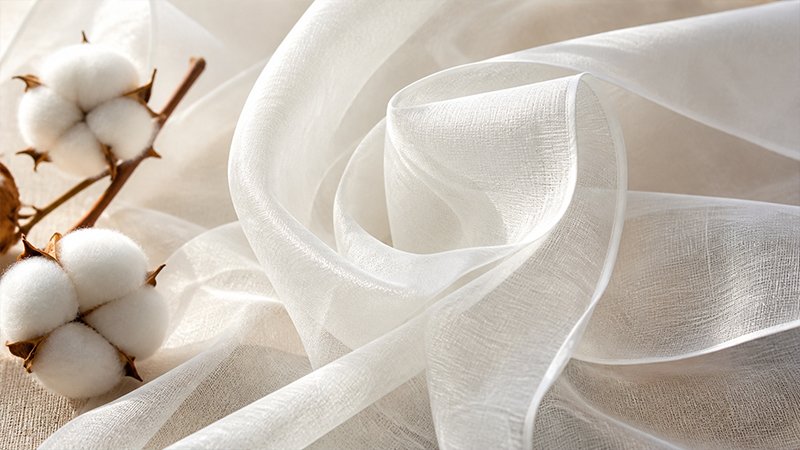
Organdy fabric is celebrated as the crispest variety of cotton in the textile industry. This semi-transparent material is a delicate, plain-weave fabric that shares structural similarities with lawn and batiste, yet offers a significantly stiffer “hand”.
Originally developed in Switzerland as a lighter alternative to French linen, modern organdy is primarily crafted from cotton fibers. Its signature rigidity is achieved through a specialized acid finishing process that carefully calibrates the final stiffness of the textile.
Historically prized for ceremonial attire such as First Communion dresses, its unique properties also make it an essential choice for garment linings to provide shape.
Today, this specialty textile remains a staple for high-fashion evening wear and summer dresses, blending elegance with structural strength.
What Exactly is Organdy Fabric?
At its core, organdy is a plain-weave textile known for its remarkable stiffness and sheer appearance. Unlike many other sheer fabrics that are soft and flowing, organdy maintains its shape with a rigidity that is almost parchment-like.
This characteristic makes it a “structural” fabric, often used to create silhouettes that require volume without the heavy weight of denser materials.
While modern organdy is exclusively a cotton-based textile, it shares a structural lineage with other plain-weave fabrics like lawn and batiste.
However, what sets it apart is the specialized finishing process that transforms soft cotton fibers into a durable, stiff, and translucent masterpiece.
The Historical Evolution: From the Swiss Alps to Global Fashion
The story of organdy begins in Switzerland, which remains one of the primary specialty producers of the fabric today. During the Middle Ages, the ancestors of organdy were crafted not from cotton, but from linen, the dominant plant-derived fiber in Europe at the time.
- The French Influence: Early precursors like lawn cloth and batiste originated in France. Swiss artisans, looking to innovate, developed organdy as a lighter and significantly crisper alternative to these French staples.
- The Cotton Revolution: In the 1600s, as the Dutch and British cotton trade expanded across Europe, textile manufacturers began substituting linen for cotton. By this period, cotton organdy became the standard, though some historians believe the original linen versions were even stiffer than what we see today.
- The Mid-Century Peak: While organdy has been used for centuries in ceremonial attire, it reached the pinnacle of mainstream fashion during the 1950s and 1960s. During this era, the “New Look” silhouette—characterized by puffy, modest dresses with full skirts—relied heavily on the structural properties of organdy.
The Science of Stiffness: How Organdy is Produced
The journey from a cotton boll to a bolt of stiff organdy is a meticulous multi-step process. Each stage is designed to enhance the fabric’s transparency and rigidity.
1. Sourcing the Finest Cotton Yarn
The process begins with the acquisition of high-quality cotton yarn, which is cleaned, carded, and spun from the bolls of the cotton plant.
2. High-Tension Spinning and Weaving
To achieve its signature thinness, the cotton yarn is tightly twisted before weaving. This high-tension spinning makes the yarn thinner and creates more space between the warp and weft fibers during the weaving process. The result is a sheer, plain-weave base that is ready for chemical transformation.
3. The Secret Ingredient: The Acid Finish
The defining characteristic of organdy—its stiffness—is not a result of the weave alone. Instead, it comes from a special acid wash process. The fabric is exposed to a chemical treatment that partially “parchmentizes” the cotton fibers. The longer the fabric is exposed to this acid, the stiffer it becomes. This allows manufacturers to calibrate the final feel of the fabric, from “soft” to “stiff” varieties.
4. Final Customization
Once the desired stiffness is achieved, the fabric may undergo bleaching to reach a “perfect white,” or it may be dyed and embroidered with intricate patterns.
The Technical Profile: Properties of Organdy
| Property | Specification |
|---|---|
| Composition | 100% Plain-weave cotton |
| Breathability | High |
| Heat Retention | Low |
| Stretchability | Low |
| Moisture-Wicking | Medium |
| Transparency | Semi-transparent/Sheer |
Due to its high breathability and low heat retention, organdy is an excellent choice for summer garments. However, it is prone to wrinkling easily, a common trait among high-stiffness cotton textiles.
Exploring the Different Types of Organdy
There are several types of organdy fabric categorized primarily by their level of stiffness, which is determined by the duration of their acid finishing process. Additionally, the sources distinguish between genuine organdy and similar textiles often mistaken for it.
Types Based on Stiffness
- Stiff Organdy: This variety undergoes the most intensive acid-washing, making it impressively rigid. Because of its extreme stiffness, it is rarely used for everyday clothing and is typically reserved for ceremonial garments.
- Semi-Stiff Organdy: This type offers a balance between reasonable stiffness and moderate softness. It is a popular choice for evening wear and women’s dresses.
- Soft Organdy: Currently the most popular variation, it is the least stiff of all organdy types while still remaining firmer than most other fabrics. It is commonly used for summer dresses and casual or semi-formal garments.
Genuine Organdy (Material Composition)
- Cotton Organdy: This is considered the only “genuine” type of organdy. While synthetic fabrics are sometimes marketed under the same name, the textile is only truly organdy if it is made from cotton. Historically, it was also made from linen, which would also be considered genuine, though this is no longer common.
Related and Often Confused Fabrics
The sources also identify textiles that are frequently confused with organdy but remain distinct:
- Silk and Synthetic Organza: While highly similar in appearance, organza is made from silk or synthetic fibers (like polyester), whereas organdy is exclusively cotton.
- Lawn Cloth and Batiste: These are also plain-weave cottons, but they are notably heavier and have a much softer “hand” than the crisp, stiff finish of organdy.
Common Uses: From First Communions to High Fashion
Organdy’s unique stiffness and semi-transparent nature make it a versatile material used across ceremonial, high-fashion, and functional textile applications.
Ceremonial and Children’s Attire
For centuries, organdy has been a traditional choice for First Communion dresses, particularly within the Catholic faith. Its ability to hold a “puffy” shape while remaining light and modest makes it ideal for flower girl dresses, baby clothing, and other girls’ apparel intended for important life events.
Because it layers well, designers often use multiple layers of organdy to create opaque, voluminous silhouettes for these ceremonial garments.
Women’s Fashion and High-End Design
In the world of adult fashion, organdy reached its peak popularity during the 1950s and 1960s, where it was favored for creating puffy, light, and modest women’s dresses. In modern contexts, it is frequently used for:
- Evening Wear and Wedding Dresses: Designers incorporate it into formal gowns and wedding attire for its structural elegance.
- Summer and Casual Wear: Soft organdy, currently the most popular variety, is a common choice for summer dresses and semi-formal garments.
- Layering: Since single layers are practically transparent, it is often designed to be worn over other garments.
Structural Linings and Tailoring
One of the most practical applications of organdy is as a lining material. Due to its remarkable stiffness, it provides the necessary structure and shape to softer fabrics that would otherwise be too shapeless. Using it as a lining also conveniently conceals the fabric’s tendency to wrinkle.
Men’s Formal Wear and Accessories
Historically, organdy was a staple for men’s collars and cuffs. While these specific accessories have largely gone out of style, the fabric is still found in men’s dress jackets and other formal apparel. It is also used for smaller items like aprons.
Home Decor
Beyond apparel, the fabric’s sheerness and rigidity make it an ideal material for curtains and various types of decorative upholstery.
The Great Textile Debate: Organdy vs. Organza vs. Lawn
While organdy, organza, and lawn cloth are all sheer, plain-weave textiles, they differ significantly in fiber composition, texture, and weight. According to the sources, the following table highlights their key differences:
| Feature | Organdy | Organza | Lawn Cloth |
|---|---|---|---|
| Fiber Composition | Primarily cotton; historically linen. | Silk or synthetic fibers (polyester, rayon). | Cotton; originally linen. |
| Texture/Hand | The crispest variety; stiff and parchment-like. | A heavier, softer relative is used as an everyday material. | Much softer hand than organdy. |
| Weight | Very light and fine. | Generally light and sheer. | Considerably heavier than organdy. |
| Transparency | Semi-transparent. | Highly transparent and sheer. | Often semi-transparent. |
| Key Distinction | Stiffness is achieved through a specialized acid finish. | Distinguished primarily by its non-cotton fiber content. | A heavier, softer relative used as an everyday material. |
Environmental Impact and Sustainability
The environmental impact and sustainability of organdy fabric are shaped by its natural composition, the methods used in cotton cultivation, and the geographic location of its production.
Overall Environmental Impact
On a global scale, the environmental footprint of organdy is considered relatively negligible because its production represents only a tiny fraction of the total annual output of the textile industry.
Because it is a natural textile made from cotton, it is inherently reasonably sustainable compared to synthetic alternatives. Unlike polyester-based fabrics, cotton fiber is highly biodegradable.
Concerns with Cotton Cultivation
Despite its natural origins, the production of the cotton required for organdy has several environmental drawbacks:
- Toxic Agrochemicals: The cultivation of cotton frequently involves the use of harmful chemicals that can impact the surrounding ecosystem.
- Soil Degradation: Cotton is one of the world’s most notorious monocrops. This practice is particularly harmful as it leads to long-lasting soil degradation.
Regional Ethics and Sustainability
Sustainability often depends on where the fabric is manufactured:
- China and India: As the largest producers of cotton and finished textiles, these regions are often associated with the exploitation of workers, which can lead to both social and environmental harm. Furthermore, manufacturers in these nations are more likely to utilize toxic chemicals during the production process.
- Western Production: Organdy produced in Western nations is generally considered more environmentally sustainable due to different manufacturing standards and regulations.
Available Certifications
To ensure the fabric meets specific ethical and environmental standards, several certifications are available:
- Organic Certifications: Organdy produced in the U.S. or the European Union may qualify for USDA or European Commission organic certification.
- International Standards: The OEKO-TEX certification provides a reliable international standard for organic textiles.
- Material Quality: Fabric made specifically from Pima cotton grown in the United States may be eligible for Supima certification.
Care and Maintenance of Organdy
To ensure the longevity of organdy fabric, which is a relatively delicate, semi-transparent cotton material, proper care and maintenance are essential. Based on the sources, here are the primary recommendations:
Washing and Cleaning
- Recommended Methods: You should typically hand-wash, dry clean, or use a cold machine wash cycle for organdy garments.
- Temperature: If machine washing, it is important to use cold water to protect the fibers.
Managing Wrinkles
- High Wrinkle Propensity: One of the defining characteristics of organdy is that it wrinkles very easily.
- Strategic Use: Because it is prone to wrinkling, designers frequently use it as a garment lining. In this application, the stiffness of the organdy provides structure to the outer fabric while its tendency to wrinkle remains concealed from view.
General Handling
- Delicacy: Organdy is considered a delicate textile. Its crispness is achieved through a specialized acid finishing process, and maintaining this unique “hand” or feel requires careful handling during the cleaning process.
- Durability: Despite its delicacy, it has a low tendency for pilling or bubbling, meaning the surface of the fabric generally remains smooth over time with proper care.
Conclusion: The Future of a Specialty Fabric
Organdy fabric remains a unique and essential specialty textile, distinguished by its unparalleled crispness and structural versatility.
From its historical roots in Switzerland as a lighter alternative to linen lawn to its modern status as a premium cotton textile, it has maintained a dedicated niche in ceremonial and high-fashion design.
Whether creating the voluminous silhouettes of First Communion dresses or serving as a hidden structural lining, organdy offers a balance of sheerness and rigidity that synthetic alternatives struggle to replicate.
While global production faces sustainability challenges related to cotton cultivation, the fabric’s biodegradable nature makes it a more environmentally conscious choice than synthetics.
Ultimately, organdy’s enduring appeal lies in providing lasting elegance and form to the most significant moments in fashion.