Kevlar fabric is one of the most recognizable high‑performance textiles ever developed. Known for its exceptional strength, heat resistance, and durability, Kevlar has become a critical material in industries ranging from personal protection and aerospace to automotive engineering and fashion innovation.
Though often associated with bulletproof vests, Kevlar’s capabilities extend far beyond body armor. This blog post explores Kevlar fabric in detail—its history, composition, properties, manufacturing process, applications, advantages, limitations, and future potential.
1. What Is Kevlar Fabric?
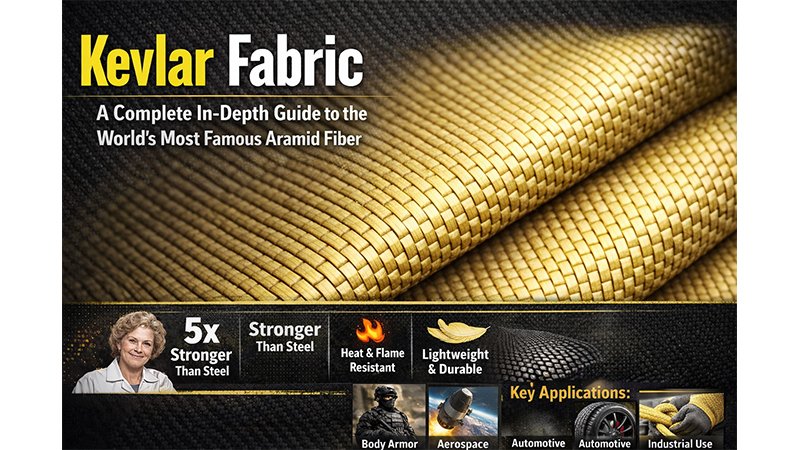
Kevlar fabric is made from Kevlar fiber, a synthetic para‑aramid polymer renowned for its extremely high tensile strength relative to its weight. On a weight‑for‑weight basis, Kevlar is approximately five times stronger than steel, making it ideal for applications that demand strength without bulk.
Kevlar fibers are spun into yarns and then woven, knitted, or layered into fabrics depending on the end use. These fabrics can be soft and flexible, rigid and laminated, or combined with resins to form advanced composites.
2. The History of Kevlar
Kevlar was invented in 1965 by chemist Stephanie Kwolek while working for DuPont. Initially developed as a lightweight alternative to steel reinforcement for tires, Kevlar quickly revealed extraordinary strength and thermal stability.
By the 1970s, Kevlar was being adopted in racing tires, industrial cables, and protective gear. Its most transformative impact came with the development of soft body armor, dramatically improving personal protection for military and law enforcement personnel. Since then, Kevlar has evolved into a cornerstone material for high‑performance engineering and safety solutions worldwide.
3. Chemical Composition and Fiber Structure
Kevlar belongs to the aramid fiber family, specifically para‑aramids. Its chemical structure is based on long molecular chains of poly‑para‑phenylene terephthalamide (PPTA). These molecules align in highly ordered, rigid structures during spinning.
Key structural features:
- Strong hydrogen bonding between polymer chains
- High crystallinity and molecular orientation
- Minimal molecular flexibility
This tightly packed molecular arrangement is the reason Kevlar exhibits such exceptional tensile strength and resistance to deformation.
4. How Kevlar Fabric Is Made
Polymer Synthesis
Kevlar begins as a liquid crystal polymer solution created through a condensation reaction involving aromatic compounds. This solution is highly viscous and requires specialized processing.
Fiber Spinning
The polymer solution is extruded through spinnerets into fibers using a wet spinning process. As fibers form, the polymer chains align along the fiber axis, locking in strength.
Yarn Formation
Individual filaments are gathered and twisted into yarns of varying thicknesses, depending on the intended application.
Fabric Construction
Kevlar yarns are transformed into fabric through:
- Weaving (plain, twill, satin)
- Knitting
- Non‑woven layering
For composite applications, fabrics are impregnated with resins such as epoxy or phenolic systems.
Physical and Mechanical Properties of Kevlar Fabric
Kevlar’s popularity stems from a unique combination of performance characteristics rarely found in a single textile.
Exceptional Strength
Kevlar’s tensile strength allows it to withstand extreme forces without breaking, making it ideal for ballistic and load‑bearing uses.
Lightweight Nature
Despite its strength, Kevlar is remarkably light, offering comfort and mobility in wearable applications.
Heat and Flame Resistance
Kevlar does not melt and begins to decompose only at temperatures above 450°C (850°F). It self‑extinguishes and does not support combustion.
Cut and Abrasion Resistance
Kevlar fabrics resist sharp objects and abrasive surfaces, widely used in industrial gloves and protective sleeves.
Dimensional Stability
Kevlar maintains its shape under stress and exhibits low elongation, ensuring structural reliability.
6. Types of Kevlar Fabric
Kevlar is not a single fabric type; it comes in multiple forms designed for specific applications.
Kevlar 29
- High toughness
- Used in ballistic armor and ropes
Kevlar 49
- Higher modulus
- Ideal for composites in aerospace and marine structures
Kevlar 129
- Enhanced ballistic performance
- Common in advanced body armor
Kevlar XP and Hybrid Fabrics
- Multi‑layer constructions
- Often combined with carbon fiber, fiberglass, or UHMWPE
7. Major Applications of Kevlar Fabric
Personal Protective Equipment (PPE)
Kevlar is most famously used in:
- Bullet‑resistant vests
- Helmets
- Cut‑resistant gloves
- Firefighter gear
Its flexibility allows armor to conform to the body while providing life‑saving protection.
Automotive and Motorsport
Kevlar is used in:
- Tire reinforcement
- Brake pads
- Clutch linings
- Racing body panels
It enhances safety and performance while reducing weight.
Aerospace and Defense
In aircraft and spacecraft, Kevlar composites reduce weight while maintaining structural integrity. Applications include:
- Aircraft panels
- Helicopter rotor protection
- Spacecraft shielding
Marine Industry
Kevlar is used in:
- Boat hull reinforcements
- Ropes and cables
- Kayaks and canoes
Its resistance to fatigue and impact makes it ideal for marine environments.
Industrial Uses
Industries rely on Kevlar for:
- Conveyor belts
- High‑pressure hoses
- Gaskets
- Vibration‑resistant components
Fashion and Consumer Products
Designers increasingly incorporate Kevlar into:
- Motorcycle clothing
- Safety footwear
- Cut‑resistant denim
- High‑end accessories
This fusion of safety and style highlights Kevlar’s versatility.
8. Advantages of Kevlar Fabric
Kevlar offers several unmatched benefits:
- Outstanding strength‑to‑weight ratio
- Thermal and flame resistance
- Long service life
- High impact and cut protection
- Chemical resistance to many solvents
These advantages justify its use in demanding and high‑risk environments.
9. Limitations and Disadvantages
Despite its strengths, Kevlar has limitations:
- UV Sensitivity: Prolonged exposure to ultraviolet light can degrade Kevlar fibers unless properly coated or protected.
- Compression Weakness: Kevlar excels in tension but is weaker under compression compared to carbon fiber.
- Moisture Absorption: Kevlar can absorb moisture, which may slightly reduce performance in certain conditions.
- Cost: Kevlar is significantly more expensive than conventional textiles, limiting its use to specialized applications.
10. Kevlar vs Other High‑Performance Fibers
Kevlar vs Carbon Fiber
- Kevlar: Tougher, more impact‑resistant
- Carbon Fiber: Stiffer, stronger in compression
Kevlar vs UHMWPE (Dyneema®)
- Kevlar: Better heat resistance
- UHMWPE: Lighter, floats on water
Kevlar vs Fiberglass
- Kevlar: Stronger and lighter
- Fiberglass: Cheaper and easier to process
11. Sustainability and Environmental Impact
Kevlar is not biodegradable, and its production is energy‑intensive. However, its long lifespan and durability reduce the need for frequent replacement, partially offsetting environmental impact.
Recycling Kevlar is challenging but improving. Mechanical recycling and reuse in secondary applications—such as insulation or composite fillers—are gaining traction.
12. Care and Handling of Kevlar Fabric
- Avoid prolonged UV exposure
- Do not bleach or use harsh chemicals
- Clean with mild detergents
- Store in dry, shaded environments
Proper care extends the performance life of Kevlar‑based products.
13. The Future of Kevlar Fabric
Research continues to push Kevlar’s boundaries through:
- Nano‑enhanced aramid fibers
- Hybrid composite systems
- Improved recyclability
- Lighter, more flexible armor designs
As industries demand stronger, lighter, and safer materials, Kevlar remains a foundational fiber in material science innovation.
Conclusion
Kevlar fabric represents a milestone in textile and materials engineering. From saving lives in protective armor to enabling cutting‑edge aerospace design, its influence spans decades and industries.
While not without limitations, Kevlar’s unmatched combination of strength, heat resistance, and durability ensures its continued relevance in a world that increasingly values performance and safety.
As technology evolves, Kevlar will not only endure—it will continue to redefine what fabrics can achieve.