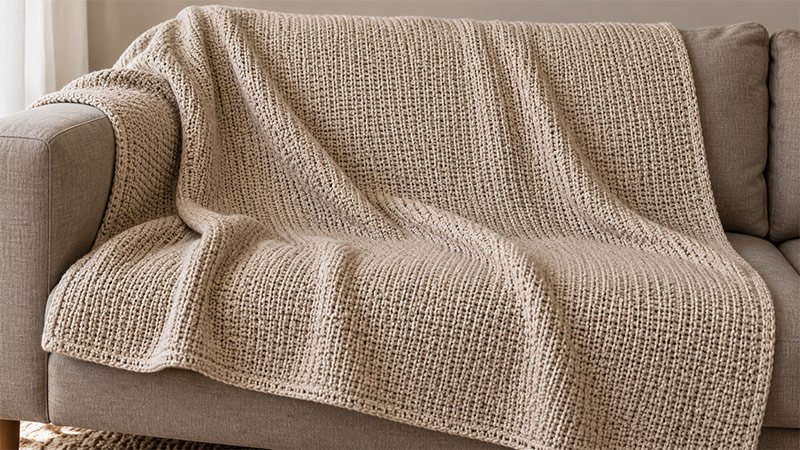
This throw uses Tunisian simple stitch. It makes small, neat bars on the front. Work the throw in one piece. Then add a single crochet border.
Each row has two parts. On the forward pass, pick up loops. On the return pass, work them off the hook.
Use one yarn shade for a plain throw. Or change shades to make stripes. Check your gauge before you start. Tunisian crochet can make firm cloth. Choose a hook that lets the stitches bend. The throw should drape with ease.
Materials
- Use a 6.5 mm Tunisian crochet hook with a cable. The cable must hold all 140 sts. A length of about 32–40 inches works well.
- Use a 5.5 mm standard crochet hook for the border. Or choose a size that keeps the edge flat.
- Use worsted-weight yarn.
- Have two removable stitch markers on hand.
- Use a yarn needle.
- Have scissors on hand.
- Use a tape measure.
- Use blocking mats and pins, if needed.
Yarn
Use worsted-weight yarn with a soft feel and clear stitch definition. Wool, acrylic, or a blend can work well.
Use the same yarn weight throughout the throw. If you plan to use more than one shade, choose yarns with the same care needs.
Make a swatch first. If the fabric feels stiff, try a larger Tunisian hook.
Yardage/Number of Skeins:
Allow approximately 2,000–2,400 yards, including the border. The amount will vary with your yarn, gauge, and tension.
Based on that range, you will need:
- 200-yard skeins: 10–12 skeins.
- 250-yard skeins: 8–10 skeins.
- 300-yard skeins: 7–8 skeins.
For a closer estimate, make a swatch and weigh it. Use its weight and area to estimate the blanket body, then allow extra yarn for the border and ends.
Abbreviations
US crochet terms are used.
- ch: Chain.
- st / sts: Stitch / stitches.
- Tss: Tunisian simple stitch.
- FwdP: Forward pass.
- RetP: Return pass.
- yo: Yarn over.
- sc: Single crochet.
- sl st: Slip stitch.
- rep: Repeat.
- RS: Right side.
Tss: Insert the hook from right to left under the front vertical bar of the next st. Yo and pull up a loop. Leave the loop on the hook.
Last edge st: Insert the hook under both vertical strands at the far edge. Yo and pull up a loop. This forms a firm edge.
RetP: Yo and pull through one loop. Then rep yo and pull through two loops until one loop remains.
Measurements
- Blanket body: About 40 × 48 inches.
- Finished throw with border: About 42 × 50 inches.
- Gauge: 14 sts and 16 complete rows = 4 inches in Tss, measured after washing and blocking.
One complete Tunisian row includes both a FwdP and a RetP.
The body has 140 sts across and 192 complete rows. The border adds about 1 inch to each side.
Pattern Instructions
Step 1: Make a Gauge Swatch
- With the Tunisian hook, ch 28.
- Work the foundation row as shown in Step 2.
- Work Tss rows until the swatch is at least 6 inches tall.
- Bind off, wash, and lay the swatch flat to dry.
- Measure the center of the swatch, away from the edges.
Use a larger hook if you have too many sts per 4 inches. Use a smaller hook if you have too few. Check the row gauge as well.
Step 2: Work the Foundation Row
Ch 140 loosely.
Row 1 — FwdP:
- Keep the loop on the hook. It counts as the first st.
- Insert the hook into the back bump of the second ch from the hook.
- Yo and pull up a loop. Leave it on the hook.
- Rep in each ch across.
You should have 140 loops on the hook.
Row 1 — RetP:
- Yo and pull through one loop.
- Yo and pull through two loops.
- Rep Step 2 until one loop remains on the hook.
Do not turn the work.
Step 3: Work the First Tss Row
Row 2 — FwdP:
- Keep the loop on the hook as the first st.
- Skip the vertical bar directly below that loop.
- Tss in each of the next 138 sts.
- Work the last edge st under both vertical strands.
You should have 140 loops on the hook.
Row 2 — RetP:
Work the standard RetP until one loop remains.
Keep the RS facing you throughout the blanket.
Step 4: Work the Blanket Body
Rows 3–192:
Rep Row 2.
- Count the loops from time to time. Each FwdP should end with 140 loops.
- Keep the first and last sts loose enough to match the rest of the row.
- Move a marker up the side every 16 rows to help track your count.
- Measure the body once it has relaxed. At the stated gauge, 192 rows give about 48 inches.
If your row gauge differs, work to the desired body length. This may change the yarn amount.
Optional stripes: Work 16 rows in each shade. Twelve 16-row sections make 192 rows. Change yarn at the start of a new FwdP, leaving a tail to weave in.
Step 5: Bind Off
After the final RetP, one loop remains on the hook.
- Skip the first vertical bar.
- Insert the hook under the front vertical bar of the next st.
- Yo and draw through the bar and the loop on the hook to make a sl st.
- Rep across to the last edge st.
- Work the final sl st under both strands of the last edge st.
- Fasten off.
Keep this row loose. If the top edge pulls inward, use a larger hook for the bind-off.
Step 6: Add the Border
Switch to the standard crochet hook.
Round 1:
- With the RS facing you, join yarn in a corner.
- Ch 1. This ch does not count as a st.
- Work 3 sc in the corner.
- Work 1 sc in each st along the next horizontal edge.
- Work 3 sc in the next corner.
- Along each side edge, begin with 3 sc for every 4 row ends. Spread them evenly.
- Continue around, working 3 sc in each corner and 1 sc in each st along the remaining horizontal edge.
- Join with a sl st to the first sc.
Work each corner only once. Place a marker in the middle sc of each 3-sc corner group.
Lay the throw flat. If the border forms waves, reduce the number of side sts. If it pulls tight, add side sts.
Rounds 2–4:
- Ch 1.
- Sc in each st around.
- Work 3 sc in each marked corner st.
- Move each marker to the middle sc of the new corner group.
- Join with a sl st to the first sc.
Fasten off after Round 4.
Step 7: Finish the Throw
- Weave in all yarn ends.
- Wash the throw as directed on the yarn label.
- Lay it flat and ease it to its finished size.
- Let it dry fully.
Tss tends to curl. A loose bind-off, a flat border, and blocking can help reduce the curl. Avoid stretching the edges so far that the stitches lose their shape.